You're building an AI-powered feature for your application and facing a critical decision: which JavaScript SDK should you use? The choice between LangChain JS, Vercel AI SDK, and OpenAI SDK determines your development velocity, bundle size, deployment options, and long-term flexibility.
This guide provides a clear decision framework matched to your specific project requirements.
In brief:
- LangChain JS offers the most comprehensive framework for complex agent workflows and RAG implementations but carries a 101.2 kB gzipped bundle and blocks edge runtime deployment.
- Vercel AI SDK delivers the best developer experience for React and Next.js applications with native edge support, streaming-first architecture, and 25+ provider integrations.
- OpenAI SDK provides the smallest bundle footprint at 34.3 kB gzipped with the highest production adoption at 8.8 million weekly downloads, optimized for direct OpenAI API access.
- Your choice depends on application complexity, framework integration needs, and deployment environment constraints.
Key Differences Between LangChain JS, Vercel AI SDK, and OpenAI SDK
Each framework makes different trade-offs between abstraction level, bundle size, and deployment flexibility. Here's how they compare across the factors that matter most.
Quick Comparison
| Feature | LangChain JS | Vercel AI SDK | OpenAI SDK |
|---|---|---|---|
| Current Version | 1.2.7 | 6.0.27 | 6.15.0 |
| Bundle Size (gzipped) | 101.2 kB | 67.5 kB | 34.3 kB |
| Weekly Downloads | 1.3M | Data unavailable | 8.8M |
| Provider Support | 50+ providers | 25+ providers (LLM + audio) | OpenAI native + limited external |
| Edge Runtime | ❌ Incompatible | ✅ Native support | ⚠️ Requires variant |
| React Hooks | ❌ Manual integration | ✅ Built-in | ❌ Manual integration |
| RAG Support | ✅ Comprehensive built-in | ⚠️ Via LangChain/LlamaIndex adapters | ❌ Manual implementation |
| Agent Architectures | ✅ Pre-built (ReAct, Plan-and-Execute, ReWOO, LLMCompiler) | ⚠️ Pattern support | ❌ Manual loops |
| Best For | Complex workflows, RAG, autonomous agents | Next.js apps, streaming chat | Direct API access, simple integrations |
What is LangChain JS?
LangChain JS is an open-source framework for building LLM-powered applications with provider abstraction for vendor independence, LangGraph-first architecture for low-level control, and a pre-built integration ecosystem. Current version 1.2.7 provides developer-friendly abstractions for autonomous agents, retrieval-augmented generation, and multi-step workflows.
LangChain JS fits when:
- Building Complex Agent Systems: Pre-built agent architectures (ReAct, Plan-and-Execute, ReWOO, LLMCompiler) with autonomous tool selection that would require 150+ manual lines with other SDKs.
- Implementing RAG: Comprehensive built-in infrastructure including document loaders, text chunking, native vector store integrations, and pre-built retrieval chains.
- Requiring Comprehensive LLM Orchestration: Multiple integration points across 50+ providers with sophisticated memory management and complex workflows.
- Framework-Agnostic Backend Development: Standalone backend services or Node.js applications without edge runtime requirements.
- Accepting Bundle Size Trade-off: 101.2 kB gzipped in exchange for feature comprehensiveness.
- Edge Runtime Incompatibility: Cannot deploy to Vercel Edge Functions or Cloudflare Workers due to Node.js
fsmodule dependency (GitHub Issue #212).
Core architecture pattern:
// config/agents/weather-agent.ts
import * as z from "zod";
import { createAgent, tool } from "langchain";

const getWeather = tool(({ city }) => `It's always sunny in ${city}!`, {
  name: "get_weather",
  description: "Get the weather for a given city",
  schema: z.object({ city: z.string() }),
});

const agent = createAgent({
  model: "claude-sonnet-4-5-20250929",
  tools: [getWeather],
});

console.log(await agent.invoke({
  messages: [{ role: "user", content: "What's the weather in Tokyo?" }]
}));
This 30-50 line LangChain implementation gives you autonomous tool selection, error handling via middleware, and streaming capabilities through configuration, compared to 150+ lines with manual OpenAI SDK implementations.
What is Vercel AI SDK?
Vercel AI SDK standardizes AI model integration across 25+ providers with a TypeScript-native, streaming-by-default architecture. Version 6.0.27 provides unified APIs for text generation, structured objects, and tool calls through AI SDK Core, while AI SDK UI offers framework-agnostic hooks for chat interfaces and generative UI.
Vercel AI SDK excels for:
- Your application uses Next.js, React, Vue, or Svelte and requires native streaming chat interfaces.
- You need provider flexibility with minimal code changes across 25+ providers.
- Edge deployment is required (only Vercel AI SDK supports native edge).
- Developer experience with streaming-first architecture matters more than bundle size (67.5 kB gzipped).
Streaming chat implementation:
// app/components/Chat.tsx
'use client';
import { useChat } from '@ai-sdk/react';
import { useState } from 'react';

export default function Chat() {
  const { messages, sendMessage, status } = useChat({
    transport: new DefaultChatTransport({ api: '/api/chat' }),
  });
  const [input, setInput] = useState('');

  return (
    <>
      {messages.map(message => (
        <div key={message.id}>
          {message.role === 'user' ? 'User: ' : 'AI: '}
          {message.parts.map((part, index) =>
            part.type === 'text' ? <span key={index}>{part.text}</span> : null
          )}
        </div>
      ))}
      <form onSubmit={e => {
        e.preventDefault();
        if (input.trim()) {
          sendMessage({ text: input });
          setInput('');
        }
      }}>
        <input
          value={input}
          onChange={e => setInput(e.target.value)}
          disabled={status !== 'ready'}
        />
        <button type="submit" disabled={status !== 'ready'}>Submit</button>
      </form>
    </>
  );
}
What is OpenAI SDK?
The OpenAI Node SDK provides direct access to OpenAI's REST API with strongly-typed inputs and outputs. Version 6.15.0 supports the latest models including modern Responses API patterns while maintaining backward compatibility with Chat Completions.
OpenAI SDK suits:
- You're committed to OpenAI models exclusively and bundle size is critical (34.3 kB gzipped).
- Granular control over API calls and error handling is required.
- Backend services need server-to-server communication without framework abstractions.
- Simple use cases don't require streaming, provider flexibility, or edge runtime support.
Basic chat completion:
// lib/openai-client.ts
import OpenAI from 'openai';

const openai = new OpenAI({
  apiKey: process.env.OPENAI_API_KEY,
});

const completion = await openai.chat.completions.create({
  model: 'gpt-4o',
  messages: [
    { role: 'user', content: 'Are semicolons optional in JavaScript?' }
  ],
});

console.log(completion.choices[0].message.content);
The SDK's streaming support uses standard Server-Sent Events (SSE):
const stream = await openai.responses.create({
  model: 'gpt-5',
  input: [{ role: 'user', content: 'Say "double bubble bath" ten times fast.' }],
  stream: true,
});

for await (const event of stream) {
  if (event.type === 'response.output_text.delta') {
    process.stdout.write(event.output.text);
  }
}
Developer Experience and API Design
The three frameworks represent distinct positions on the abstraction spectrum.
OpenAI SDK uses the most direct approach with minimal abstraction and exact API mirroring, though you implement streaming state management, retry logic, and error handling yourself.
Vercel AI SDK optimizes for UI integration with purpose-built React hooks. The useChat() and useCompletion() hooks reduce boilerplate to approximately 20 lines for a complete chat interface versus 100+ lines with direct API usage, though this creates framework lock-in.
LangChain JS provides the highest-level abstractions with object-oriented patterns based on its LangGraph-first architecture, with the steepest learning curve but simplifying complex workflows once understood.
TypeScript support is comprehensive across all three. OpenAI SDK generates types from OpenAPI specifications. Both Vercel AI SDK and LangChain JS integrate Zod for schema validation with automatic type inference, giving you compile-time safety for tool parameters and structured outputs.
Tool calling implementation reveals the abstraction differences clearly:
const { text } = await generateText({
  model: openai('gpt-4o'),
  tools: {
    weather: tool({
      description: 'Get current weather data for a city',
      parameters: z.object({
        city: z.string().describe('The city name')
      }),
      execute: async ({ city }) => {
        const response = await fetch(`https://api.weather.service/current?city=${city}`);
        const data = await response.json();
        return {
          temperature: data.temp,
          condition: data.condition,
          humidity: data.humidity
        };
      }
    })
  },
  prompt: 'What is the weather in San Francisco?'
});
Community feedback consistently favors Vercel AI SDK for "cleaner APIs, solid TypeScript support, and better streaming," while developers appreciate OpenAI SDK for "stability and debugging simplicity." LangChain JS is recognized as "powerful but sometimes overly complex" for straightforward use cases.
Streaming Support and Real-Time Response Handling
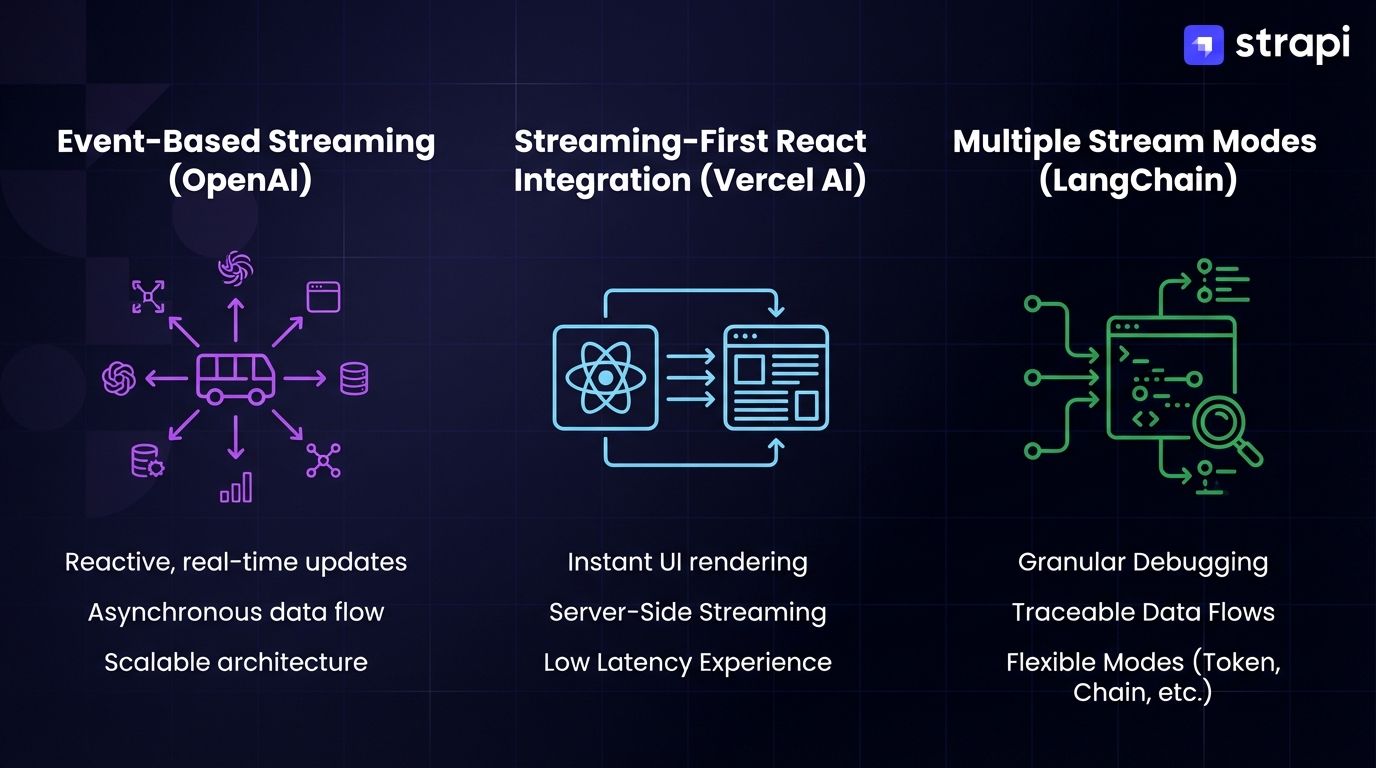
Streaming capabilities separate these frameworks significantly. Vercel AI SDK provides the highest-level abstraction with purpose-built React hooks, LangChain JS uses async iterators requiring manual React integration, and OpenAI SDK offers event-driven streaming with the most granular control.
Vercel AI SDK provides the highest-level abstractions with purpose-built React hooks (useChat, useCompletion, useAssistant) that eliminate manual state management entirely. The framework returns AsyncIterable<string> for server-side streaming and ReadableStream for Edge Functions, with built-in React hooks handling connection management, chunk processing, and re-renders automatically.
For teams looking to build production chatbots, this efficiency through Vercel's built-in React hooks for streaming demonstrates significant boilerplate reduction compared to equivalent functionality with other SDKs.
LangChain JS uses async iterators for streaming with the stream(input) method, which returns an async iterator you can consume in a loop, while streamEvents() provides granular control over individual events.
OpenAI SDK offers the most granular control through semantic event-driven patterns with events like response.created, response.output_text.delta, and response.completed for precise rendering control. For ultra-low latency real-time applications, the Realtime API delivers WebRTC (browser) and WebSocket (server) connectivity bypassing standard HTTP.
Edge runtime compatibility creates a critical deployment constraint. Vercel AI SDK offers explicit edge support with native V8 compatibility. LangChain JS is fundamentally incompatible due to Node.js fs module usage, which isn't available in edge environments. OpenAI SDK requires the openai-edge variant for edge compatibility.
If your architecture requires edge deployment for low latency or global distribution, LangChain JS cannot be used regardless of other factors.
Performance characteristics vary by use case. Vercel's edge infrastructure processes billions of tokens daily with single-digit millisecond round-trip times. Edge functions show approximately 9x faster cold starts compared to serverless. OpenAI SDK performance depends primarily on model characteristics rather than SDK overhead.
Model Provider Flexibility
Provider flexibility determines your ability to switch between AI services and avoid vendor lock-in.
- Vercel AI SDK supports 25+ providers including OpenAI, Anthropic, Google Generative AI, AWS Bedrock, Azure OpenAI, xAI Grok, Mistral, and specialized services for audio (ElevenLabs, LMNT) and transcription (Deepgram, AssemblyAI). Provider switching requires minimal code changes through unified interface patterns.
- LangChain JS integrates 50+ providers including OpenAI, Anthropic, Google Gemini, Azure OpenAI, AWS Bedrock, and Ollama for local inference through its prefix-based pattern.
- OpenAI SDK provides limited external provider support through platform-mediated routing. You can access Google, Anthropic (via AWS Bedrock), Together, and Fireworks models, but configuration happens through OpenAI's model selection interface.
For applications requiring true multi-provider flexibility, particularly when you want to A/B test providers or distribute load across services, Vercel AI SDK stands out with 25+ integrated providers and single-line model switching, while LangChain JS offers strong support with 50+ providers. OpenAI SDK requires more manual configuration for external providers, making it less ideal for frequent provider experimentation.
Provider switching becomes critical during API outages or rate limiting. With Vercel AI SDK, changing from OpenAI to Anthropic requires modifying only the model identifier, while maintaining identical streaming, tool calling, and error handling code paths. This operational resilience matters when production systems face service degradation.
Agents, Tool Calling, and RAG Capabilities
LangChain JS provides the most mature agent infrastructure with pre-built architectures including ReAct (reasoning and acting iteratively) and Plan-and-Execute (multi-step workflows). You get autonomous tool selection, error handling via middleware through wrapToolCall, and streaming through config.streamWriter.
import * as z from "zod";
import { createAgent, tool } from "langchain";

const getWeather = tool(({ city }) => `It's always sunny in ${city}!`, {
  name: "get_weather",
  description: "Get the weather for a given city",
  schema: z.object({ city: z.string() }),
});

const agent = createAgent({
  model: "claude-sonnet-4-5-20250929",
  tools: [getWeather],
});

console.log(await agent.invoke({
  messages: [{ role: 'user', content: "What's the weather in Tokyo?" }]
}));
Vercel AI SDK provides flexible primitives for agentic patterns through tool calling. You implement patterns like ReAct or Plan-and-Execute by composing tool calls with custom orchestration logic (approximately 80-120 lines of code). The needsApproval flag enables human-in-the-loop workflows.
OpenAI SDK requires manual implementation of agent loops. The SDK supports function calling with JSON schema definitions, but you write the decision logic, execution loop, and state management yourself, typically requiring 150-200 lines for comparable functionality.
RAG support shows significant differences. LangChain JS provides comprehensive built-in capabilities with native vector store integrations, document loaders for various formats, chunking strategies, and pre-built retrieval chains. The framework supports traditional two-step retrieval, agentic RAG where agents decide what to retrieve, and hybrid approaches. AI FAQ implementation demonstrates how this architecture leverages structured content retrieval.
Vercel AI SDK uses an adapter-based approach, with RAG implementations typically integrating LangChain or LlamaIndex adapters. OpenAI SDK requires building all vector storage, document loading, and chunking infrastructure separately.
| Feature | LangChain JS | Vercel AI SDK | OpenAI SDK |
|---|---|---|---|
| Agent Types | Pre-built (ReAct, Plan-and-Execute) | Pattern support | Manual |
| Native RAG | ✅ Built-in | Via adapters | External |
| Vector Stores | Multiple built-in | Via integrations | Developer-implemented |
| Lines of Code | 30-50 | 80-120 | 150-200 |
Bundle Size and Edge Runtime Compatibility
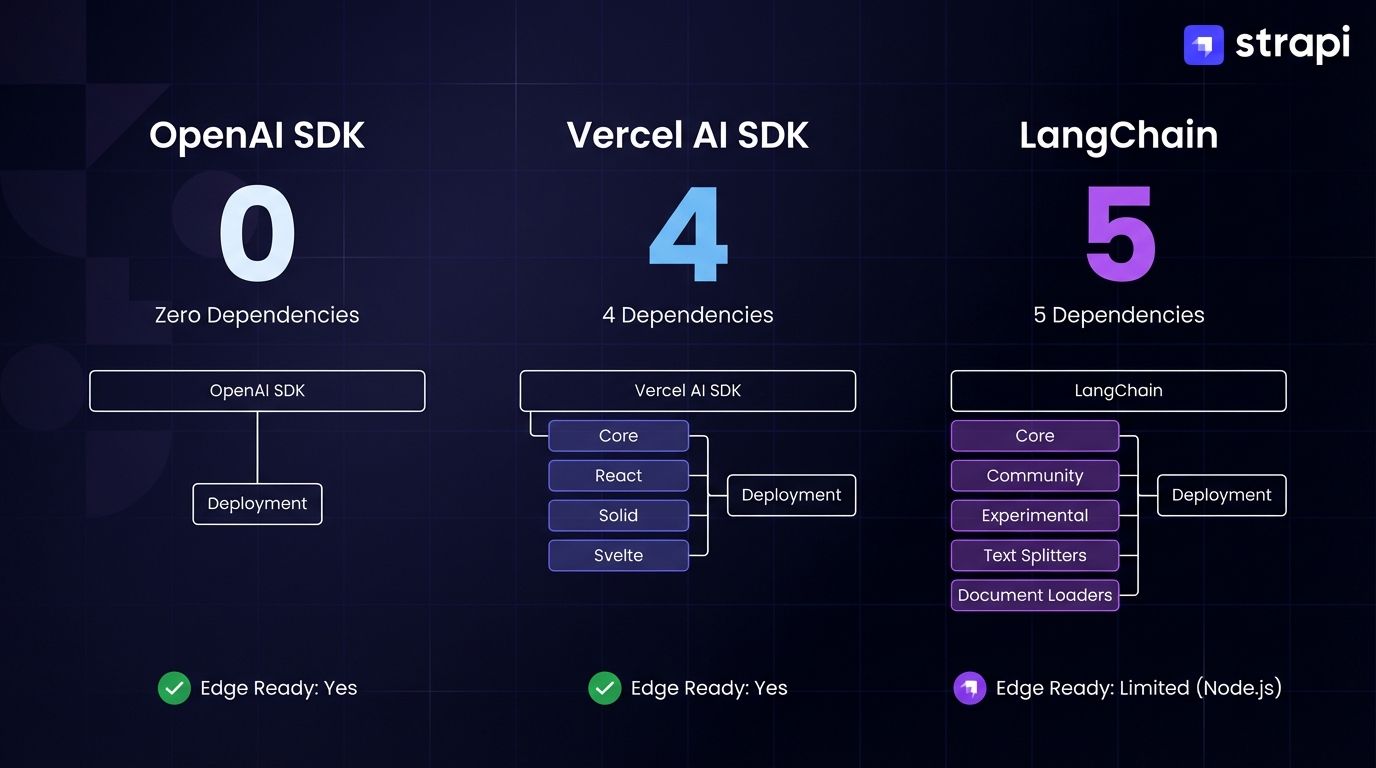
Bundle sizes reveal the cost of abstraction layers:
- OpenAI SDK: 34.3 kB gzipped (smallest, most efficient for client-side).
- Vercel AI SDK: 67.5 kB gzipped (2x OpenAI, acceptable for modern web apps).
- LangChain JS: 101.2 kB gzipped (3x OpenAI, reflects comprehensive features).
For modern web performance targeting 100-200 kB gzipped initial loads, OpenAI SDK is ideal for client-side applications where every kilobyte matters. Vercel AI SDK's 67.5 kB remains reasonable for most use cases, while LangChain JS reaches the upper limits though tree-shaking can reduce this through granular imports.
Edge runtime compatibility creates a critical decision point:
LangChain JS: ❌ Incompatible with Edge Runtimes
- Uses Node.js
fsmodule unavailable in edge environments (GitHub Issue #212). - Hard technical blocker with no workaround.
- Limited to Node.js serverless only.
Vercel AI SDK: ✅ Full Edge Runtime Support
- Designed for V8-based Edge Runtime.
- Optimized for Vercel's edge infrastructure.
OpenAI SDK: ⚠️ Edge Compatible with Modifications
- Requires
openai-edgevariant. - Standard SDK uses
axioswhich isn't edge-compatible.
This constraint dramatically changes decision trees. Projects requiring edge deployment must exclude LangChain JS entirely, leaving only Vercel AI SDK (native edge support) or OpenAI SDK with the openai-edge variant.
Community Support and Ecosystem Maturity
Production adoption measured by weekly npm downloads:
- OpenAI SDK: 8.8 million weekly downloads (production leader by 7x).
- LangChain JS: 1.3 million weekly downloads (substantial adoption).
- Vercel AI SDK: Download data unavailable.
Developer engagement measured by GitHub stars:
- Vercel AI SDK: 20.8k stars (highest community interest).
- LangChain JS: 16.7k stars (80% of Vercel's engagement).
- OpenAI SDK: 10.5k stars (50% of Vercel's engagement).
Active maintenance across all three frameworks:
- LangChain JS: v1.2.7 (January 8, 2026) with five releases in eight days.
- Vercel AI SDK: v6.0.27 (January 10, 2026) with major version December 2025.
- OpenAI SDK: v6.15.0 (December 19, 2025) with consistent minor releases.
All three maintain comprehensive official documentation with extensive guides, framework-specific patterns, and complete API references. When integrating headless CMS capabilities, official documentation quality becomes critical for troubleshooting integration points.
When to Use Each Framework
Consider Vercel AI SDK when:
You're building an AI-powered Next.js application requiring real-time chat interfaces. The useChat() and useCompletion() hooks deliver production-ready streaming with automatic message state management. Edge runtime support enables global distribution with low latency. Provider flexibility across 25+ providers maintains optionality without code rewrites.
For deploying AI features to Vercel's edge network, native integration provides the optimal path.
Turn to LangChain JS for:
Your application requires complex multi-step reasoning with autonomous agents, retrieval-augmented generation with vector stores, or sophisticated workflow orchestration. LangChain JS offers pre-built agent architectures and comprehensive RAG tooling with native vector store integrations that significantly reduce implementation effort.
Provider abstraction across 50+ LLM providers enables sophisticated multi-model workflows, though edge runtime compatibility limitations restrict deployment to Node.js serverless environments.
OpenAI SDK optimizes for:
You need direct API access to OpenAI with granular control over parameters, request lifecycle, error handling, and streaming behavior. The smallest bundle footprint (34.3 kB gzipped) makes it ideal for client-side applications where performance matters. Exclusive OpenAI API access without multi-provider flexibility requirements eliminates abstraction overhead.
Making the Right Choice for Your AI Application
No single framework wins across all dimensions. OpenAI SDK dominates production adoption (8.8M weekly downloads) with the smallest bundle (34.3 kB gzipped)—ideal for straightforward OpenAI integration. Vercel AI SDK leads developer engagement (20.8k GitHub stars) with unmatched React/Next.js experience through built-in hooks and edge runtime support. LangChain JS offers the most comprehensive agent and RAG infrastructure despite edge incompatibility and larger bundle size.
Key decision factors:
- Edge deployment required? Exclude LangChain JS. Use Vercel AI SDK (native) or OpenAI SDK (edge variant).
- Complex agents or RAG? LangChain JS is strongly favored.
- Next.js streaming UI? Vercel AI SDK reduces implementation from 100+ lines to ~20.
- Simple completions? OpenAI SDK's minimal abstraction works best.
AI application development with Strapi as your content backend maintains flexibility across all three frameworks through standard REST and GraphQL APIs. Strapi's AI-powered content type builder and LLM Translator plugin work with any OpenAI-compatible provider.
The AI landscape evolves rapidly—all three frameworks shipped major updates in Q4 2025 and Q1 2026. Monitor provider support, edge compatibility, and community momentum for long-term decisions.