eCommerce platforms have evolved beyond simple shopping cart plugins into managed SaaS solutions, open-source headless backends, and enterprise frameworks—each with distinct trade-offs for developer productivity, performance, and maintainability. Choosing the right foundation matters because migrating later means rebuilding integrations, retraining teams, and risking downtime.
Developers evaluate five platforms most frequently: Shopify (SaaS for fast launches), Medusa (open-source headless commerce on Node.js/TypeScript), traditional PHP CMS platforms (commerce integration with content management), BigCommerce (mid-market SaaS with B2B capabilities), and Magento (enterprise implementations with sophisticated customization).
This analysis focuses on what matters for web developers: API design, extensibility patterns, hosting models, and the operational reality of maintaining these platforms in production.
In brief
- Shopify and BigCommerce provide fully managed SaaS with different fee structures: Shopify charges transaction fees (2.9% + $0.30 on Shopify Payments, or 0.5%-2% additional fees on third-party gateways), while BigCommerce charges zero transaction fees but enforces sales threshold upgrades.
- Medusa provides complete backend control through Node.js and PostgreSQL but requires managing full infrastructure: servers, databases, security patches, monitoring, and scaling.
- Traditional PHP CMS commerce solutions enable extensive plugin ecosystems but require critical caching infrastructure (Varnish, Redis, Memcached) for stores with 1000+ products.
- Magento delivers multi-store architecture and advanced B2B workflows (company hierarchies, approval processes, negotiated pricing) but demands specialized infrastructure, including Elasticsearch, Redis, RabbitMQ, and load balancers.
At-a-Glance Comparison Table
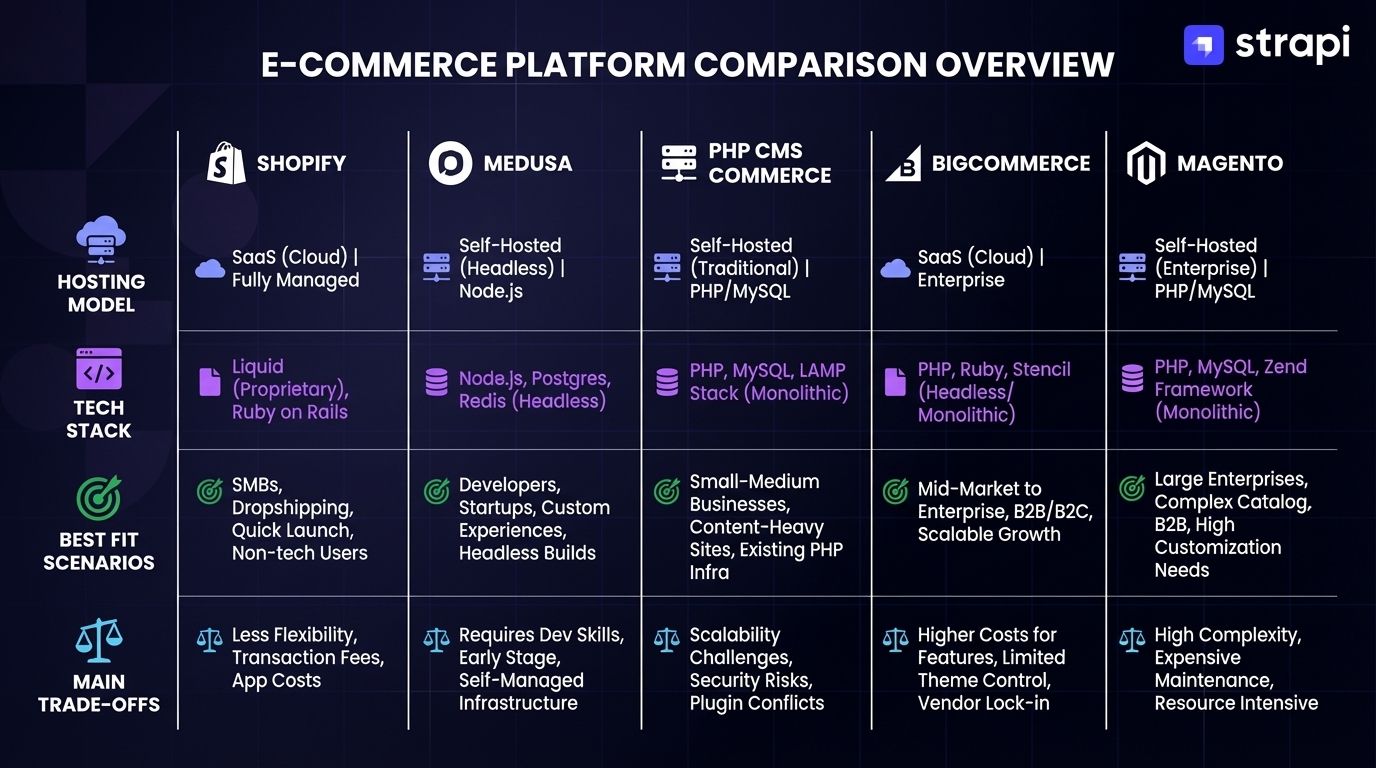
This comparison highlights architectural differences, tech stacks, and the practical trade-offs you'll encounter when building production stores.
| Platform | Model and Stack | Best Fit | Key Developer Pros | Key Developer Cons |
|---|---|---|---|---|
| Shopify | Hosted SaaS, Liquid templates, React (Hydrogen), GraphQL APIs | Standard storefronts, DTC brands, headless builds needing reliability | Polished tooling (CLI 3.87.4), comprehensive APIs, zero infrastructure responsibility | Checkout customization limited to Plus tier, 2% platform fees on third-party gateways (Basic plan) |
| Medusa | Open-source, Node.js/TypeScript, PostgreSQL, REST APIs | Custom experiences, JS-first teams, migration from SaaS limitations | Full code-level control, zero transaction fees, bidirectional Strapi sync | You own DevOps (hosting, scaling, monitoring), smaller ecosystem than established platforms |
| PHP CMS Commerce | CMS plugin, PHP/MySQL, REST APIs | Content-commerce hybrid sites, existing CMS infrastructure | Massive plugin ecosystem, low entry cost, familiar CMS patterns | Performance requires aggressive caching, hosting quality directly impacts user experience |
| BigCommerce | Hosted SaaS, Stencil (Handlebars), GraphQL Storefront API | Mid-market, complex catalogs, B2B features out-of-box | Zero transaction fees, built-in B2B, Catalyst framework | Sales threshold upgrades enforced, fewer apps than Shopify, SaaS constraints on deep customization |
| Magento | Self-hosted or cloud, PHP, MySQL, GraphQL/REST APIs | Enterprise multi-store, complex B2B, large teams with specialized skills | Maximum flexibility, modular architecture supporting multi-tenant deployments, complete multi-store control | Steep learning curve, $22K+ annual licensing, demands enterprise infrastructure |
If you need to ship quickly without managing servers, you'll want to prioritize the hosted SaaS options (Shopify, BigCommerce). If your team has strong DevOps capabilities and JavaScript expertise, Medusa provides a modern headless architecture with complete backend control.
For teams experienced with traditional PHP CMS platforms, commerce plugins offer familiar customization patterns. If your organization already deploys enterprise PHP infrastructure, Magento provides advanced B2B features and modular architecture. You'll want to match the platform's infrastructure complexity to your team's actual operational capacity, not your aspirations.
Shopify
Shopify fits projects where managed infrastructure and proven commerce logic matter more than unlimited customization. You can launch standard storefronts quickly using Liquid templates.
Direct-to-consumer brands benefit from integrated payments, fulfillment, and marketing tools. Headless implementations leverage the Storefront API when you need custom frontends while retaining Shopify's backend reliability.
Architecture and Tech Stack
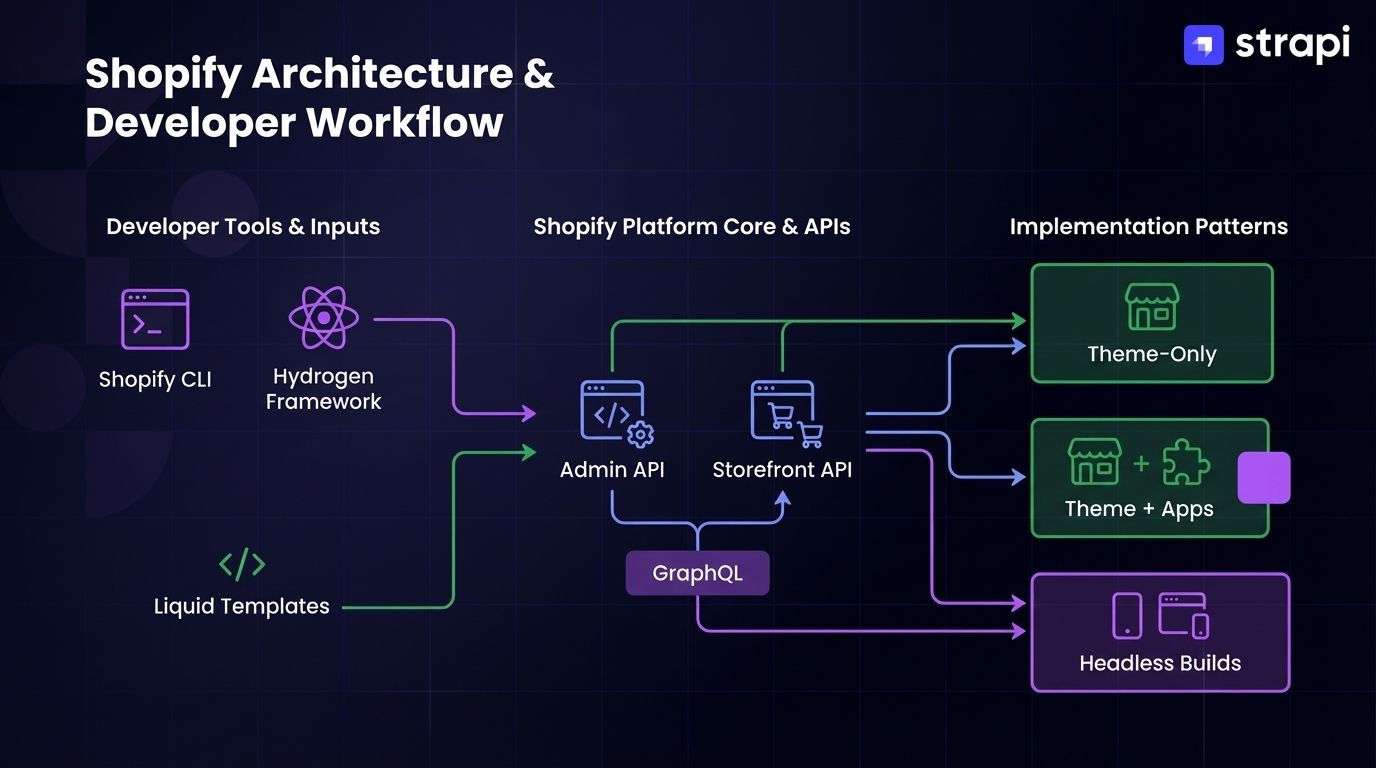
Shopify's core concepts center on Liquid for templating, with REST and GraphQL for programmatic access. Theme-based builds use Liquid's {{ }} for output, {% %} for logic, and filters for data transformation. The architecture supports three patterns: theme-only stores, theme plus apps for extending functionality, and fully headless builds with Next.js or Nuxt consuming the Storefront API.
The GraphQL Storefront API provides product queries, cart management, and checkout handling. For administrative operations, the Admin API exclusively uses GraphQL (REST endpoints are deprecated for new development). Authentication uses OAuth for apps and API tokens for server integrations, with query complexity limits preventing abuse.
Here's a typical Storefront API query for fetching product data:
query GetProduct($handle: String!) {
  productByHandle(handle: $handle) {
    id
    title
    description
    priceRange {
      minVariantPrice {
        amount
        currencyCode
      }
    }
    images(first: 5) {
      edges {
        node {
          url
          altText
        }
      }
    }
    variants(first: 10) {
      edges {
        node {
          id
          title
          price {
            amount
            currencyCode
          }
          availableForSale
        }
      }
    }
  }
}
Headless implementations typically use Hydrogen, Shopify's official React-based framework optimized for the Storefront API with built-in server-side rendering support.
Customization and Extensibility
You extend Shopify through apps, webhooks, and API integrations. Apps install via OAuth and can modify admin interfaces, add payment or shipping logic, and implement custom workflows. Shopify supports webhook events including order creation and inventory updates.
Checkout customization capabilities are limited on standard Shopify tiers. Shopify Plus opens expanded checkout extensibility through Scripts and Functions, though this tier begins at $2,300 monthly.
Developer Experience, Cost, Trade-offs
Developer experience centers on mature tooling. The Shopify CLI handles app scaffolding, theme development with local preview servers, and deployment automation.
Cost structures include subscription tiers from $39 to $399 monthly for standard plans. Transaction fees create hidden costs: using third-party payment gateways adds 2% platform fees on Basic plans, dropping to 0.6% on Advanced.
For stores processing $100,000 monthly through third-party gateways, that's $2,000 in platform fees alone on Basic plans. App marketplace costs accumulate quickly ($10 to $50 monthly per app for common needs).
Trade-offs favor reliability and speed over low-level control. Headless implementations via Storefront API provide complete frontend control but require managing authentication, rate limits, and performance optimization.
Medusa
Medusa fits teams comfortable owning their entire backend infrastructure. You get a modern Node.js and TypeScript stack with service-oriented architecture, PostgreSQL database requirements, and REST API design that you can extend through modules, workflows, and plugins.
The open-source model means zero licensing fees, but you assume complete operational responsibility for infrastructure provisioning, database management, security patches, monitoring, and scaling.
Architecture and Tech Stack
The architecture implements API-first modularity with clear separation: backend services handle commerce logic, admin interfaces manage operations, and frontends connect via REST APIs. Core technology includes Node.js with TypeScript for type safety, PostgreSQL (required), and TypeORM for database operations.
Modules organize code into self-contained units with their own data models, services, repositories, and API routes. Dependency injection via Awilix promotes loose coupling, where services are automatically registered and resolved at runtime.
Here's how you fetch products using Medusa's REST API:
// Fetch products with filters and pagination
fetch('https://your-medusa-backend.com/store/products?limit=20&offset=0&category_id[]=cat_123', {
  credentials: 'include'
})
  .then(response => response.json())
  .then(({ products, count, offset, limit }) => {
    console.log(`Found ${count} products`);
    products.forEach(product => {
      console.log(`${product.title}: ${product.variants[0].prices[0].amount / 100}`);
    });
  });

// Add item to cart
fetch('https://your-medusa-backend.com/store/carts/cart_123/line-items', {
  method: 'POST',
  credentials: 'include',
  headers: { 'Content-Type': 'application/json' },
  body: JSON.stringify({
    variant_id: 'variant_456',
    quantity: 1
  })
})
  .then(response => response.json())
  .then(({ cart }) => console.log('Cart updated:', cart));
Frontend integration options are completely flexible via REST APIs, with Next.js officially supported through starter templates.
Customization and Extensibility
Code-level extensibility defines Medusa's approach. You modify data models directly, extend core services through inheritance, customize business logic in workflows, and swap implementations via providers.
The plugin system packages reusable functionality as NPM modules that can include custom modules with data models, API routes, workflows, admin UI extensions, database migrations, and custom services.
Event-driven patterns enable reactive logic: subscribers listen for events like product.created or order.placed and trigger custom workflows.
Developer Experience, Cost, Trade-offs
Developer experience favors engineering-heavy teams comfortable with infrastructure. You provision servers, manage PostgreSQL instances, configure Redis for caching, implement monitoring, handle backups, and scale infrastructure as traffic grows.
Medusa Cloud offers managed hosting with a Hobby tier starting at $29/month, a Pro tier starting at $299 per monthh for production workloads, and custom Enterprise pricing, all with zero transaction fees.
Cost profiles differ from SaaS: Medusa charges no additional platform or GMV-based fees beyond your payment processor's transaction costs. However, this economic advantage comes with significantly increased DevOps investment.
Teams with existing DevOps expertise and modern JavaScript infrastructure view this trade-off as acceptable for architectural freedom and cost control at scale.
Traditional PHP CMS Commerce
Traditional PHP CMS commerce solutions fit content-heavy stores where editorial and transactional functionality coexist.
Blogs adding product sales, content-driven brands requiring advanced publishing tools, and teams with existing PHP CMS expertise represent natural fits. The plugin architecture means commerce functionality lives alongside posts, pages, and media in a unified system.
Architecture and Tech Stack
CMS plugin architecture provides the foundation: commerce functionality extends the base CMS rather than replacing it. The PHP/MySQL stack typically requires PHP 7.4 or higher with specific hosting configurations for optimal performance.
Effective production deployments require server-level caching (Varnish, NGINX FastCGI Cache), object caching (Redis, Memcached), and regular database optimization for stores with 1,000+ products. You'll need caching through multiple layers: object caching with Redis for database query results, page caching for full HTML responses, and browser caching for static assets.
Customization and Extensibility
Extensive plugin ecosystems provide pre-built solutions for most scenarios. Popular extensions typically include subscriptions, bookings, and membership functionality at annual licensing costs ranging from $199 to $299 per extension.
The hooks and filters system enables customization without modifying core code through actions (event-driven hooks) and filters (data transformation hooks). This pattern allows you to intercept commerce workflows, modify product data, customize checkout processes, and extend admin interfaces.
Headless options exist via REST APIs, though building headless implementations means consuming REST endpoints directly and handling authentication, state management, and performance optimization yourself.
Developer Experience, Cost, Trade-offs
Your developer experience ties directly to hosting infrastructure and platform choices. Quality hosting that provides adequate server resources, caching support, and database optimization significantly improves performance.
Cost dynamics favor low entry barriers: open-source software with no licensing fees or platform transaction fees. However, extension costs accumulate, hosting requirements scale with store size, and developer time spent on performance optimization represents significant hidden costs.
Trade-offs favor content-commerce integration and ecosystem familiarity over performance-optimized architecture. Teams with PHP CMS expertise move quickly, while those without face learning curve overhead.
BigCommerce
BigCommerce positions for mid-market and enterprise implementations requiring SaaS convenience with advanced features. Complex product catalogs with hundreds of variants, multi-channel selling across marketplaces, and teams wanting headless options without self-hosting infrastructure represent ideal scenarios. Built-in B2B differentiates it from consumer-focused platforms.
Architecture and Tech Stack
Hosted backend with built-in commerce features eliminates infrastructure management. Stencil themes use Handlebars templating for traditional storefronts. For headless implementations, Catalyst (BigCommerce's official Next.js framework) provides React components, GraphQL integration, and optimized performance patterns.
The GraphQL Storefront API enables efficient data fetching. This API-first design supports fully custom frontends while leveraging BigCommerce's backend infrastructure, with the embedded checkout option enabling stores to use BigCommerce's optimized checkout without building a custom implementation.
Customization and Extensibility
You extend BigCommerce through apps, APIs, and webhooks without direct backend modification. The app ecosystem includes both free and paid options, typically $10-$300 monthly. BigCommerce provides extensive built-in features including advanced product options and customer segmentation that reduce the need for extensive app dependencies.
API access enables custom integrations with ERP systems, marketing automation, or order management platforms. Webhooks notify external systems of events, enabling reactive workflows.
Developer Experience, Cost, Trade-offs
Developer tooling includes the Stencil CLI for theme development and the Storefront API Playground for testing GraphQL queries. Documentation at developer.bigcommerce.com provides thorough coverage.
Zero platform fees represent a key differentiator: you pay only payment processor fees. Plan pricing ranges from $39 to $399 monthly for standard tiers. However, sales threshold enforcement creates potential surprises: exceeding your plan's annual sales limit forces upgrades.
Trade-offs favor feature-rich SaaS with operational simplicity. You customize through APIs and hosted SDKs rather than modifying core code.
Magento / Adobe Commerce
Magento serves enterprise commerce requiring multi-tier architecture supporting clustered deployments, advanced customization through modular PHP development, and substantial DevOps expertise.
Organizations with large product catalogs, complex B2B workflows (built-in company hierarchies, approval processes, negotiated pricing), and strategic platform independence justify the investment. You'll need teams with strong PHP development expertise, MySQL/MariaDB proficiency, and infrastructure experience.
Architecture and Tech Stack
PHP architecture implements MVC patterns, SOLID principles, and dependency injection throughout. Magento 2.4.8 requires PHP 8.3+, MySQL 8.0 or MariaDB 10.4+, and OpenSearch 2.x (OpenSearch is required, not optional, replacing Elasticsearch).
Deployment options include Adobe Commerce Cloud for managed hosting and Magento Open Source for self-hosted deployments. For self-hosted implementations at scale, multi-tier architecture includes web server clusters, database primary and replicas, Elasticsearch clusters, Redis, RabbitMQ, and load balancers.
Headless implementations consume REST or GraphQL APIs. The GraphQL API supports complex queries for B2B scenarios, including company hierarchies, negotiable quotes, and purchase orders.
Customization and Extensibility
You extend functionality through custom modules using the plugin system (interceptors), service contracts, and event observers. The module architecture promotes independence: modules operate with minimal dependencies, enabling granular customization while maintaining upgrade compatibility.
Dependency injection replaces legacy patterns with DI throughout, promoting loose coupling. High-level classes depend on abstractions rather than concrete implementations.
Developer Experience, Cost, Trade-offs
You'll face a steep learning curve reflecting architectural complexity. You'll need strong PHP skills, database optimization expertise, and understanding of dependency injection patterns. Official training includes certification paths.
Infrastructure demands exceed typical PHP applications, requiring multi-tier architecture with dedicated servers for web, database, search, and message queue layers plus comprehensive caching strategy.
High total cost of ownership: Adobe Commerce licensing starts around $22,000 annually and scales with Gross Merchandise Value. Beyond licensing, infrastructure costs, specialized developer salaries, and ongoing maintenance create substantial investment requirements.
How Does Strapi Integrate with eCommerce Platforms?
Strapi functions as a headless CMS providing API-first content management that integrates with eCommerce platforms. This composable commerce approach separates content management (handled by Strapi) from transactional commerce operations. Multi-channel content delivery enables serving the same content to web storefronts, mobile apps, and marketing sites from a single source.
Decoupling content from commerce enables content teams to manage rich storytelling, brand content, and marketing campaigns independently. While the commerce platform handles product transactional data, Strapi provides enhanced content management including rich text editing, advanced media management, multi-language support, and flexible content modeling via API-first architecture.
Integration Patterns per Platform
- Shopify and BigCommerce patterns combine Strapi content with product data in unified frontends. Shopify implementations leverage the Shopify Admin API with webhook-driven synchronization, while the Storefront API is used for fetching storefront data. BigCommerce implementations use the BigCommerce GraphQL with webhooks notifying Strapi of product changes.
- Medusa integration implements the tightest coupling through an official plugin enabling bidirectional synchronization. Medusa emits product events to its event bus, the Strapi plugin listens and updates content, while Strapi webhooks notify Medusa of content changes. Configuration requires shared authentication and webhook setup, with a working reference implementation available.
- Traditional PHP CMS commerce and Magento approaches treat systems as parallel data sources. Frontends query both APIs and merge responses client-side or through middleware. Commerce REST APIs provide commerce data while Strapi serves content through its REST and GraphQL.
Developer Benefits
Content iteration happens in Strapi without touching commerce codebases. Marketing teams modify landing pages, update blog content, and adjust promotional messaging independently. Strapi provides REST and GraphQL APIs for content access, with typed content APIs improving developer experience through predictable structures that type generation tools consume.
This headless architecture leverages each platform's strengths: commerce systems handle transactions, inventory, and orders, while Strapi manages content presentation, rich media, and multi-language support.
Choosing the Right Platform
Choose Shopify for fast launches with managed infrastructure. Medusa fits JavaScript-first teams comfortable owning backend operations. Traditional PHP CMS commerce suits content-heavy stores under 1,000 products.
BigCommerce provides mid-market features with zero transaction fees and built-in B2B. Magento serves enterprise needs requiring complex multi-store architecture.
Deploy proof-of-concept implementations testing authentication, checkout customization, and system integrations before committing.
For advanced content management, Strapi's API-first architecture complements any platform through REST and GraphQL APIs. Strapi AI enables intelligent content workflows while maintaining separation from commerce backends, protecting long-term flexibility.