

In the previous tutorial, we completed our Home Page. Now we'll build out our Sign In and Sign Up pages and implement the authentication logic to enable user registration and login.
- Part 1: Learn Next.js by building a website
- Part 2: Building Out The Hero Section of the homepage
- Part 3: Finishup up the homepage Features Section, TopNavigation and Footer
- Part 4: How to handle login and Authentification in Next.js
- Part 5: Building out the Dashboard page and upload file using NextJS server actions
- Part 6: Get Video Transcript with AI SDK
- Part 7: Strapi CRUD permissions
- Part 8: Search & pagination in Nextjs
- Part 9: Backend deployment to Strapi Cloud
- Part 10: Frontend deployment to Vercel
Let's start by creating our routes.
How To Group Routes In Next.js
Next.js allows us to group routes and create shared layouts. You can read more here. For our use case, we'll create a route group called auth. To create a route group, you create a folder with a name enclosed in parentheses.
Our folder structure will look like the following.
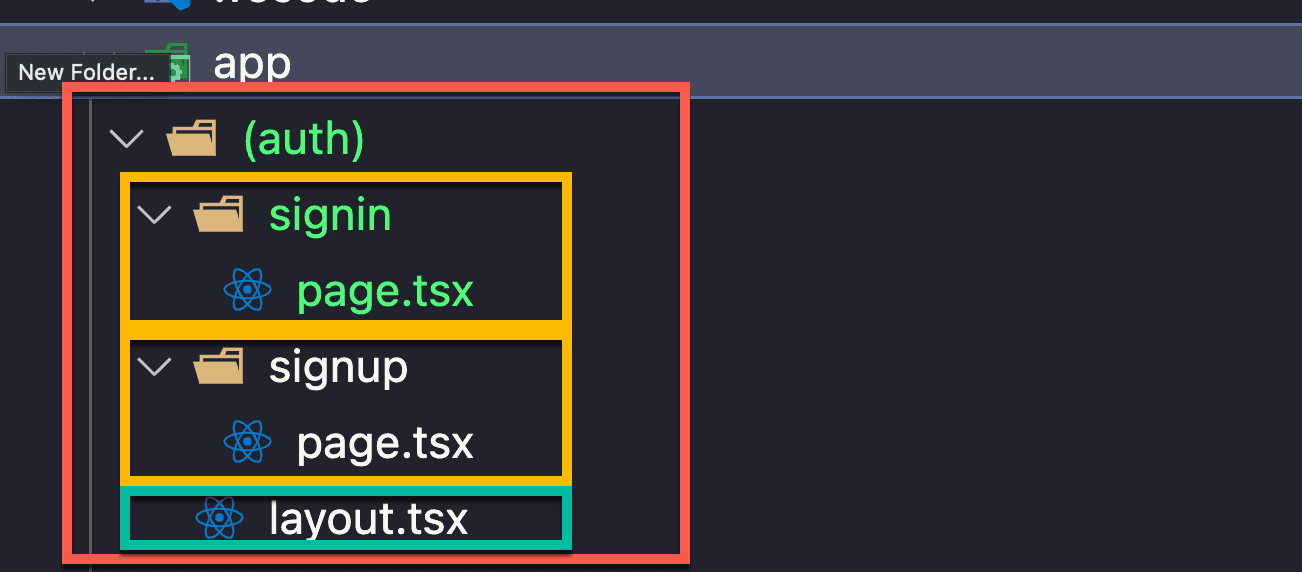
- A folder named
(auth) - Inside the
(auth)folder, create two additional folders:signinandsignup, each with a blankpage.tsxfile - Finally, inside the
(auth)folder, create a file calledlayout.tsxto serve as our shared layout between thesigninandsignuppages
You can learn more about the layout.tsx file in Next.js docs here
Now that we have our basic folder structure, let's create the following components.
In the layout.tsx file, paste the following code.
export default function AuthLayout({
  children,
}: {
  readonly children: React.ReactNode;
}) {
  return (
    <div className="flex flex-col items-center justify-center min-h-screen bg-gray-100 dark:bg-gray-900">
      {children}
    </div>
  );
}
Paste the following code in the signin/page.tsx file.
export default function SignInRoute() {
  return <div>Sign In Route</div>;
}
Paste the following code in the signup/page.tsx file.
export default function SingUpRoute() {
  return <div>Sign Up Route</div>;
}
After creating these components, you should be able to navigate to our signin page via the link.
Building Our Signin and Signup Form
Let's navigate to app/components and create a new folder called forms. Inside that folder, create two new files: signin-form.tsx and signup-form.tsx, and paste the following code for the respective components.
signin-form.tsx
"use client";
import Link from "next/link";
import {
CardTitle,
CardDescription,
CardHeader,
CardContent,
CardFooter,
Card,
} from "@/components/ui/card";
import { Label } from "@/components/ui/label";
import { Input } from "@/components/ui/input";
import { Button } from "@/components/ui/button";
const styles = {
container: "w-full max-w-md",
header: "space-y-1",
title: "text-3xl font-bold text-pink-500",
content: "space-y-4",
fieldGroup: "space-y-2",
footer: "flex flex-col",
button: "w-full",
prompt: "mt-4 text-center text-sm",
link: "ml-2 text-pink-500",
};
export function SigninForm() {
return (
<div className={styles.container}>
<form>
<Card>
<CardHeader className={styles.header}>
<CardTitle className={styles.title}>Sign In</CardTitle>
<CardDescription>
Enter your details to sign in to your account
</CardDescription>
</CardHeader>
<CardContent className={styles.content}>
<div className={styles.fieldGroup}>
<Label htmlFor="email">Email</Label>
<Input
id="identifier"
name="identifier"
type="text"
placeholder="username or email"
/>
</div>
<div className={styles.fieldGroup}>
<Label htmlFor="password">Password</Label>
<Input
id="password"
name="password"
type="password"
placeholder="password"
/>
</div>
</CardContent>
<CardFooter className={styles.footer}>
<Button className={styles.button}>Sign In</Button>
</CardFooter>
</Card>
<div className={styles.prompt}>
Don't have an account?
<Link className={styles.link} href="signup">
Sign Up
</Link>
</div>
</form>
</div>
);
}signup-form.tsx
"use client";
import Link from "next/link";

import {
  CardTitle,
  CardDescription,
  CardHeader,
  CardContent,
  CardFooter,
  Card,
} from "@/components/ui/card";

import { Label } from "@/components/ui/label";
import { Input } from "@/components/ui/input";
import { Button } from "@/components/ui/button";

const styles = {
  container: "w-full max-w-md",
  header: "space-y-1",
  title: "text-3xl font-bold text-pink-500",
  content: "space-y-4",
  fieldGroup: "space-y-2",
  footer: "flex flex-col",
  button: "w-full",
  prompt: "mt-4 text-center text-sm",
  link: "ml-2 text-pink-500",
};

export function SignupForm() {
  return (
    <div className={styles.container}>
      <form>
        <Card>
          <CardHeader className={styles.header}>
            <CardTitle className={styles.title}>Sign Up</CardTitle>
            <CardDescription>
              Enter your details to create a new account
            </CardDescription>
          </CardHeader>
          <CardContent className={styles.content}>
            <div className={styles.fieldGroup}>
              <Label htmlFor="username">Username</Label>
              <Input
                id="username"
                name="username"
                type="text"
                placeholder="username"
              />
            </div>
            <div className={styles.fieldGroup}>
              <Label htmlFor="email">Email</Label>
              <Input
                id="email"
                name="email"
                type="email"
                placeholder="name@example.com"
              />
            </div>
            <div className={styles.fieldGroup}>
              <Label htmlFor="password">Password</Label>
              <Input
                id="password"
                name="password"
                type="password"
                placeholder="password"
              />
            </div>
          </CardContent>
          <CardFooter className={styles.footer}>
            <Button className={styles.button}>Sign Up</Button>
          </CardFooter>
        </Card>
        <div className={styles.prompt}>
          Have an account?
          <Link className={styles.link} href="signin">
            Sign In
          </Link>
        </div>
      </form>
    </div>
  );
}
Since we're using Shadcn UI, we need to install the card, input, and label components that we're using in the code above.
You can learn more about Shadcn UI here
We can install the components by running the following command:
npx shadcn@latest add card label inputNow that we've installed our components, let's navigate to app/(auth)/signin/page.tsx and import our newly created SigninForm component.
The final code should look like the following.
import { SigninForm } from "@/components/forms/signin-form";

export default function SingInRoute() {
  return <SigninForm />;
}
Let's do the same for the signup/page.tsx file by updating it as follows:
import { SignupForm } from "@/components/forms/signup-form";

export default function SingUoRoute() {
  return <SignupForm />;
}
Now restart your frontend Next.js application. You should see the following when navigating to the Sign In page:
Excellent! We now have both of our forms. Before diving into the details of implementing form submission via Server Actions, here are some great resources to learn more about the process: MDN HTML Forms and specific to Next.js Server Action & Mutations
Now let's dive into building out our SignupForm.
Form Submission Using Next.js Server Actions
We'll first focus on our SignupForm, and then, after we understand how things work, we'll make the same changes to our SigninForm.
While building our form, let's consider these key concepts in the context of Next.js:
- We can get form values via the
nameattribute in theinputfields inside the form - The form will have an action attribute pointing to a server action
- When we click the submit
button, it will submit the form and trigger our action - We'll be able to access our data inside the server action via FormData
- Inside the server action, our business logic will handle signup via our Strapi backend
Let's start by defining our first Next.js server action. Navigate to src/app/data and create a new folder called actions with index.ts and auth.ts files.
Inside our newly created auth.ts file, let's paste the following code:
"use server";

export async function registerUserAction(formData: FormData) {
  console.log("Hello From Register User Action");
}
And in the index.ts file, paste the following:
import { registerUserAction } from "./auth";

export const actions = {
  auth: {
    registerUserAction,
  },
};
Now let's import our registerUserAction in our signup-form.tsx file and add it to our form action.
import { actions } from "@/data/actions";Update the form action attribute with the following:
{
  /*  rest of our code  */
}
      <form action={actions.auth.registerUserAction}>
{
  /*  rest of our code  */
}
Now, you should be able to click the Sign Up button, and we should see our console log in our terminal since it's being executed on the server.
Excellent! Now that we know how to trigger our server action via form submission, let's examine how we can access our form data via FormData.
How To Access FormData Inside Next.js Server Action
For additional reading, I recommend checking out this post about FormData on MDN, but we'll be using the get method to retrieve our values.
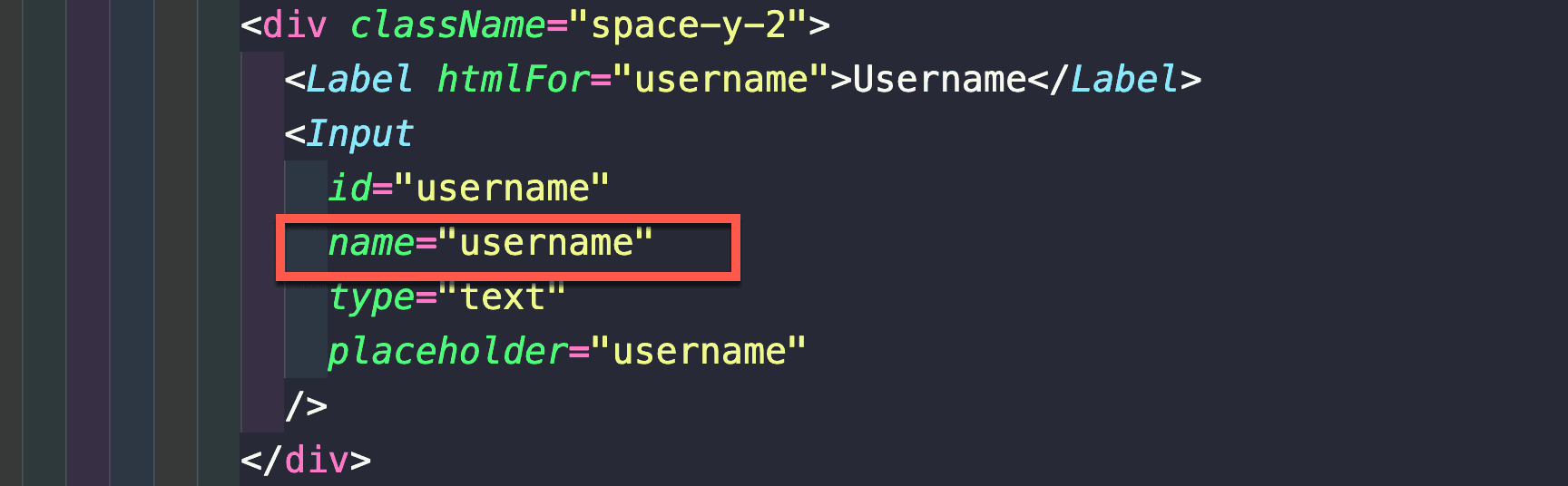
When we submit our form, the values will be passed to our server action via FormData using the input name attribute as the key for our value.
For example, we can retrieve our data using FormData.get("username") for the following input.
Let's update our registerUserAction action in the auth.ts file with the following code:
"use server";

export async function registerUserAction(formData: FormData) {
  console.log("Hello From Register User Action");

  const fields = {
    username: formData.get("username") as string,
    password: formData.get("password") as string,
    email: formData.get("email") as string,
  };

  console.log("#############");
  console.log(fields);
  console.log("#############");
}Now, fill out the fields in the Signup form and click the Sign Up button. You should see the following console log in your terminal.
Hello From Register User Action
#############
{
  username: 'testuser',
  password: 'testuser',
  email: 'testuser@email.com'
}
#############
We can now get our data in our server action, but how do we return or validate it?
That's what we'll cover in our next section.
How To Get Form State With useActionState Hook
We'll use React's useActionState hook to return data from our server action. You can learn more here.
Back in the signup-form.tsx file.
We'll first import our useActionState hook from react-dom:
import { useActionState } from "react";Now, let's create a variable to store our initial state:
const INITIAL_STATE = {
  data: null,
};
Now let's use our useActionState hook:
const [formState, formAction] = useActionState(
  actions.auth.registerUserAction,
  INITIAL_STATE
);

console.log("## will render on client ##");
console.log(formState);
console.log("###########################");
And update the form action attribute with the following:
<form action={formAction}>The completed code should look like the following.
"use client";
import { useActionState } from "react";
import Link from "next/link";
import { actions } from "@/data/actions";

import {
  CardTitle,
  CardDescription,
  CardHeader,
  CardContent,
  CardFooter,
  Card,
} from "@/components/ui/card";

import { Label } from "@/components/ui/label";
import { Input } from "@/components/ui/input";
import { Button } from "@/components/ui/button";

const styles = {
  container: "w-full max-w-md",
  header: "space-y-1",
  title: "text-3xl font-bold text-pink-500",
  content: "space-y-4",
  fieldGroup: "space-y-2",
  footer: "flex flex-col",
  button: "w-full",
  prompt: "mt-4 text-center text-sm",
  link: "ml-2 text-pink-500",
};

const INITIAL_STATE = {
  data: null,
};

export function SignupForm() {
  const [formState, formAction] = useActionState(
    actions.auth.registerUserAction,
    INITIAL_STATE
  );

  console.log("## will render on client ##");
  console.log(formState);
  console.log("###########################");
  return (
    <div className={styles.container}>
      <form action={formAction}>
        <Card>
          <CardHeader className={styles.header}>
            <CardTitle className={styles.title}>Sign Up</CardTitle>
            <CardDescription>
              Enter your details to create a new account
            </CardDescription>
          </CardHeader>
          <CardContent className={styles.content}>
            <div className={styles.fieldGroup}>
              <Label htmlFor="username">Username</Label>
              <Input
                id="username"
                name="username"
                type="text"
                placeholder="username"
              />
            </div>
            <div className={styles.fieldGroup}>
              <Label htmlFor="email">Email</Label>
              <Input
                id="email"
                name="email"
                type="email"
                placeholder="name@example.com"
              />
            </div>
            <div className={styles.fieldGroup}>
              <Label htmlFor="password">Password</Label>
              <Input
                id="password"
                name="password"
                type="password"
                placeholder="password"
              />
            </div>
          </CardContent>
          <CardFooter className={styles.footer}>
            <Button className={styles.button}>Sign Up</Button>
          </CardFooter>
        </Card>
        <div className={styles.prompt}>
          Have an account?
          <Link className={styles.link} href="signin">
            Sign In
          </Link>
        </div>
      </form>
    </div>
  );
}
Finally, we need to update our registerUserAction action in the auth.ts file using the following code:
"use server";

export async function registerUserAction(prevState: any, formData: FormData) {
  console.log("Hello From Register User Action");

  const fields = {
    username: formData.get("username") as string,
    password: formData.get("password") as string,
    email: formData.get("email") as string,
  };

  console.log("#############");
  console.log(fields);
  console.log("#############");

  return {
    ...prevState,
    data: fields,
  };
}
We'll fix the use of any in a bit when we use Zod for validation.
When you submit the form, you should see our data console logged in our frontend via the console.log(formState); that we have in our signup-form.tsx file.
This is great! We can pass data to our server action and return it via useActionState.
Before we see how to submit our form and sign up via our Strapi backend, let's examine how to handle form validation with Zod.
Form Validation In Next.js with Zod
Zod is a validation library designed for use with TypeScript and JavaScript. In this project we'll be using the newly released Zod 4.
You can reference the following to see what has changed docs.
It offers an expressive syntax for creating complex validation schemas, which makes Zod particularly useful for validating user-generated data, such as information submitted through forms or received from API requests, to ensure the data aligns with your application's expected structures and types.
Let's examine how we can add Zod validation for our forms. We'll choose to do the validation inside our server action.
Let's start by installing Zod with the following command:
yarn add zodOnce the installation is complete, go to the data directory, create a new folder named validation, then add a file called auth.ts with the following code:
import { z } from "zod";

export const SigninFormSchema = z.object({
  identifier: z
    .string()
    .min(3, "Username or email must be at least 3 characters"),
  password: z
    .string()
    .min(6, "Password must be at least 6 characters")
    .max(100, "Password must be less than 100 characters"),
});

export const SignupFormSchema = z.object({
  username: z
    .string()
    .min(3, "Username must be at least 3 characters")
    .max(20, "Username must be less than 20 characters"),
  email: z.email("Please enter a valid email address"),
  password: z
    .string()
    .min(6, "Password must be at least 6 characters")
    .max(100, "Password must be less than 100 characters"),
});

export type SigninFormValues = z.infer<typeof SigninFormSchema>;
export type SignupFormValues = z.infer<typeof SignupFormSchema>;

export type FormState = {
  success?: boolean;
  message?: string;
  data?: {
    identifier?: string;
    username?: string;
    email?: string;
    password?: string;
  };
  strapiErrors?: {
    status: number;
    name: string;
    message: string;
    details?: Record<string, string[]>;
  } | null;
  zodErrors?: {
    identifier?: string[];
    username?: string[];
    email?: string[];
    password?: string[];
  } | null;
};
Here, we're setting up two Zod schemas—one for signing in and one for signing up—along with a FormState type to help us track what's happening with our form.
- SigninFormSchema validates that the identifier (username or email) is at least 3 characters long, and the password is between 6 and 100 characters
- SignupFormSchema validates that the username is between 3 and 20 characters, the email is valid, and the password follows the same 6–100 character rule
We also have some TypeScript types:
- SigninFormValues and SignupFormValues give us the exact shape of valid form data for each schema
- FormState keeps track of:
- Whether the request was successful and any message we want to show
- The actual form data we're working with
- Any Zod validation errors before the form even gets sent
- Any Strapi API errors we'll handle once we hook this up to our backend later in the tutorial
Now, let's update our registerUserAction to use our schema to validate our fields by making the following changes:
"use server";

import { z } from "zod";
import { SignupFormSchema, type FormState } from "@/data/validation/auth";

export async function registerUserAction(
  prevState: FormState,
  formData: FormData
): Promise<FormState> {
  console.log("Hello From Register User Action");

  const fields = {
    username: formData.get("username") as string,
    password: formData.get("password") as string,
    email: formData.get("email") as string,
  };

  const validatedFields = SignupFormSchema.safeParse(fields);

  if (!validatedFields.success) {
    const flattenedErrors = z.flattenError(validatedFields.error);
    console.log("Validation failed:", flattenedErrors.fieldErrors);
    return {
      success: false,
      message: "Validation failed",
      strapiErrors: null,
      zodErrors: flattenedErrors.fieldErrors,
      data: {
        ...prevState.data,
        ...fields,
      },
    };
  }

  console.log("Validation successful:", validatedFields.data);

  // TODO: WE WILL ADD STRAPI LOGIC HERE LATER

  return {
    success: true,
    message: "User registration successful",
    strapiErrors: null,
    zodErrors: null,
    data: {
      ...prevState.data,
      ...fields,
    },
  };
}
In the above code, we’re using Zod to validate the data submitted from our user registration form.
The SignupFormSchema.safeParse() method checks the username, password, and email values extracted from the formData.
If validation fails (validatedFields.success is false), we use z.flattenError() to format the errors, log them, and return the previous form state along with a failure message and the field-specific error details.
If validation succeeds, we log the valid data and return the updated form state with a success flag and message.
This validation step ensures that all registration data meets our defined rules before sending out request to Strapi.
Before testing our form, we just have to make one small change inside our signup-form.tsx file.
First let's import our FormState type:
import { type FormState } from "@/data/validation/auth";And update our INITIAL_STATE with the following:
const INITIAL_STATE: FormState = {
  success: false,
  message: undefined,
  strapiErrors: null,
  zodErrors: null,
};
The completed code should look like the following:
"use client";
import { type FormState } from "@/data/validation/auth";
import { useActionState } from "react";
import Link from "next/link";
import { actions } from "@/data/actions";

import {
  CardTitle,
  CardDescription,
  CardHeader,
  CardContent,
  CardFooter,
  Card,
} from "@/components/ui/card";

import { Label } from "@/components/ui/label";
import { Input } from "@/components/ui/input";
import { Button } from "@/components/ui/button";

const styles = {
  container: "w-full max-w-md",
  header: "space-y-1",
  title: "text-3xl font-bold text-pink-500",
  content: "space-y-4",
  fieldGroup: "space-y-2",
  footer: "flex flex-col",
  button: "w-full",
  prompt: "mt-4 text-center text-sm",
  link: "ml-2 text-pink-500",
};

const INITIAL_STATE: FormState = {
  success: false,
  message: undefined,
  strapiErrors: null,
  zodErrors: null,
};

export function SignupForm() {
  const [formState, formAction] = useActionState(
    actions.auth.registerUserAction,
    INITIAL_STATE
  );

  console.log("## will render on client ##");
  console.log(formState);
  console.log("###########################");
  return (
    <div className={styles.container}>
      <form action={formAction}>
        <Card>
          <CardHeader className={styles.header}>
            <CardTitle className={styles.title}>Sign Up</CardTitle>
            <CardDescription>
              Enter your details to create a new account
            </CardDescription>
          </CardHeader>
          <CardContent className={styles.content}>
            <div className={styles.fieldGroup}>
              <Label htmlFor="username">Username</Label>
              <Input
                id="username"
                name="username"
                type="text"
                placeholder="username"
              />
            </div>
            <div className={styles.fieldGroup}>
              <Label htmlFor="email">Email</Label>
              <Input
                id="email"
                name="email"
                type="email"
                placeholder="name@example.com"
              />
            </div>
            <div className={styles.fieldGroup}>
              <Label htmlFor="password">Password</Label>
              <Input
                id="password"
                name="password"
                type="password"
                placeholder="password"
              />
            </div>
          </CardContent>
          <CardFooter className={styles.footer}>
            <Button className={styles.button}>Sign Up</Button>
          </CardFooter>
        </Card>
        <div className={styles.prompt}>
          Have an account?
          <Link className={styles.link} href="signin">
            Sign In
          </Link>
        </div>
      </form>
    </div>
  );
}
Let's test our form by not adding any of our fields and submitting it.
Notice we can see our errors in the front end. Let's create a new component called ZodErrors to help us display them inside our signup-form.tsx file.
First, navigate to src/app/components/custom, create a new file called zod-errors.tsx, and paste it into the following code.
interface IZodErrorsProps {
  error?: string[];
}

export function ZodErrors({ error }: IZodErrorsProps) {
  if (!error) return null;
  return error.map((err: string, index: number) => (
    <div key={index} className="text-pink-500 text-xs italic mt-1 py-2">
      {err}
    </div>
  ));
}
Now, navigate to src/app/components/forms/signup-form.tsx and let's use the following component.
We will import and add it to our form and pass the zod errors we are getting back from our formState.
The updated signup-form.tsx code should look like the following. Also notice that we are using defaultValue to populate previously entered field data.
"use client";
import { type FormState } from "@/data/validation/auth";
import { useActionState } from "react";
import Link from "next/link";
import { actions } from "@/data/actions";

import {
  CardTitle,
  CardDescription,
  CardHeader,
  CardContent,
  CardFooter,
  Card,
} from "@/components/ui/card";

import { Label } from "@/components/ui/label";
import { Input } from "@/components/ui/input";
import { Button } from "@/components/ui/button";

import { ZodErrors } from "@/components/custom/zod-errors";

const styles = {
  container: "w-full max-w-md",
  header: "space-y-1",
  title: "text-3xl font-bold text-pink-500",
  content: "space-y-4",
  fieldGroup: "space-y-2",
  footer: "flex flex-col",
  button: "w-full",
  prompt: "mt-4 text-center text-sm",
  link: "ml-2 text-pink-500",
};

const INITIAL_STATE: FormState = {
  success: false,
  message: undefined,
  strapiErrors: null,
  zodErrors: null,
};

export function SignupForm() {
  const [formState, formAction] = useActionState(
    actions.auth.registerUserAction,
    INITIAL_STATE
  );

  console.log("## will render on client ##");
  console.log(formState);
  console.log("###########################");
  return (
    <div className={styles.container}>
      <form action={formAction}>
        <Card>
          <CardHeader className={styles.header}>
            <CardTitle className={styles.title}>Sign Up</CardTitle>
            <CardDescription>
              Enter your details to create a new account
            </CardDescription>
          </CardHeader>
          <CardContent className={styles.content}>
            <div className={styles.fieldGroup}>
              <Label htmlFor="username">Username</Label>
              <Input
                id="username"
                name="username"
                type="text"
                placeholder="username"
              />
              <ZodErrors error={formState?.zodErrors?.username} />
            </div>
            <div className={styles.fieldGroup}>
              <Label htmlFor="email">Email</Label>
              <Input
                id="email"
                name="email"
                type="email"
                placeholder="name@example.com"
              />
              <ZodErrors error={formState?.zodErrors?.email} />
            </div>
            <div className={styles.fieldGroup}>
              <Label htmlFor="password">Password</Label>
              <Input
                id="password"
                name="password"
                type="password"
                placeholder="password"
              />
              <ZodErrors error={formState?.zodErrors?.password} />
            </div>
          </CardContent>
          <CardFooter className={styles.footer}>
            <Button className={styles.button}>Sign Up</Button>
          </CardFooter>
        </Card>
        <div className={styles.prompt}>
          Have an account?
          <Link className={styles.link} href="signin">
            Sign In
          </Link>
        </div>
      </form>
    </div>
  );
}
Now, restart your frontend Next.js project and try submitting the form without entering any data; you should see the following errors.
Although our errors show up correctly, notice that are previous field entry disapears. We need to let our form to access previos values, we can do this by using defaultValue and passing our previous state via formState.
defaultValue={formState?.data?.username || ""}The updated code will look like the following:
"use client";
import { type FormState } from "@/data/validation/auth";
import { useActionState } from "react";
import Link from "next/link";
import { actions } from "@/data/actions";

import {
  CardTitle,
  CardDescription,
  CardHeader,
  CardContent,
  CardFooter,
  Card,
} from "@/components/ui/card";

import { Label } from "@/components/ui/label";
import { Input } from "@/components/ui/input";
import { Button } from "@/components/ui/button";

import { ZodErrors } from "@/components/custom/zod-errors";

const styles = {
  container: "w-full max-w-md",
  header: "space-y-1",
  title: "text-3xl font-bold text-pink-500",
  content: "space-y-4",
  fieldGroup: "space-y-2",
  footer: "flex flex-col",
  button: "w-full",
  prompt: "mt-4 text-center text-sm",
  link: "ml-2 text-pink-500",
};

const INITIAL_STATE: FormState = {
  success: false,
  message: undefined,
  strapiErrors: null,
  zodErrors: null,
};

export function SignupForm() {
  const [formState, formAction] = useActionState(
    actions.auth.registerUserAction,
    INITIAL_STATE
  );

  console.log("## will render on client ##");
  console.log(formState);
  console.log("###########################");
  return (
    <div className={styles.container}>
      <form action={formAction}>
        <Card>
          <CardHeader className={styles.header}>
            <CardTitle className={styles.title}>Sign Up</CardTitle>
            <CardDescription>
              Enter your details to create a new account
            </CardDescription>
          </CardHeader>
          <CardContent className={styles.content}>
            <div className={styles.fieldGroup}>
              <Label htmlFor="username">Username</Label>
              <Input
                id="username"
                name="username"
                type="text"
                placeholder="username"
                defaultValue={formState?.data?.username || ""}
              />
              <ZodErrors error={formState?.zodErrors?.username} />
            </div>
            <div className={styles.fieldGroup}>
              <Label htmlFor="email">Email</Label>
              <Input
                id="email"
                name="email"
                type="email"
                placeholder="name@example.com"
                defaultValue={formState?.data?.email || ""}
              />
              <ZodErrors error={formState?.zodErrors?.email} />
            </div>
            <div className={styles.fieldGroup}>
              <Label htmlFor="password">Password</Label>
              <Input
                id="password"
                name="password"
                type="password"
                placeholder="password"
                defaultValue={formState?.data?.password || ""}
              />
              <ZodErrors error={formState?.zodErrors?.password} />
            </div>
          </CardContent>
          <CardFooter className={styles.footer}>
            <Button className={styles.button}>Sign Up</Button>
          </CardFooter>
        </Card>
        <div className={styles.prompt}>
          Have an account?
          <Link className={styles.link} href="signin">
            Sign In
          </Link>
        </div>
      </form>
    </div>
  );
}
Notice now we are able to keep our previos fields entries.
Nice. Now that we have our form validation working, let's move on and create a service that will handle our Strapi Auth Login.
Authentication with Next.js and Strapi
Now, let's implement Strapi authentication by registering our user via our Strapi API. You can find the process explained here
The basic overview,
- request to register user to Strapi
- after the user is created, we will get back a JWT token
- save the cookie via the
httpOnlycookie - redirect the user to the
dashboard. - handle Strapi errors if any exist
Let's start by creating a service that will handle Strapi User Registration.
Navigate to src/app/data and create a new folder called services inside. Create the file auth.ts and paste it into the following code.
import { getStrapiURL } from "@/lib/utils";
import type { TStrapiResponse, TImage } from "@/types";
import { actions } from "@/data/actions";
import qs from "qs";

type TRegisterUser = {
  username: string;
  password: string;
  email: string;
};

type TLoginUser = {
  identifier: string;
  password: string;
};

type TAuthUser = {
  id: number;
  documentId: string;
  username: string;
  email: string;
  firstName?: string;
  lastName?: string;
  bio?: string;
  image?: TImage;
  credits?: number;
  provider: string;
  confirmed: boolean;
  blocked: boolean;
  createdAt: string;
  updatedAt: string;
  publishedAt: string;
};

type TAuthResponse = {
  jwt: string;
  user: TAuthUser;
};

type TAuthServiceResponse = TAuthResponse | TStrapiResponse<null>;

// Type guard functions
export function isAuthError(
  response: TAuthServiceResponse
): response is TStrapiResponse<null> {
  return "error" in response;
}

export function isAuthSuccess(
  response: TAuthServiceResponse
): response is TAuthResponse {
  return "jwt" in response;
}

const baseUrl = getStrapiURL();

export async function registerUserService(
  userData: TRegisterUser
): Promise<TAuthServiceResponse | undefined> {
  const url = new URL("/api/auth/local/register", baseUrl);

  try {
    const response = await fetch(url, {
      method: "POST",
      headers: {
        "Content-Type": "application/json",
      },
      body: JSON.stringify({ ...userData }),
    });

    const data = (await response.json()) as TAuthServiceResponse;
    console.dir(data, { depth: null });
    return data;
  } catch (error) {
    console.error("Registration Service Error:", error);
    return undefined;
  }
}

export async function loginUserService(
  userData: TLoginUser
): Promise<TAuthServiceResponse> {
  const url = new URL("/api/auth/local", baseUrl);

  try {
    const response = await fetch(url, {
      method: "POST",
      headers: {
        "Content-Type": "application/json",
      },
      body: JSON.stringify({ ...userData }),
    });

    return response.json() as Promise<TAuthServiceResponse>;
  } catch (error) {
    console.error("Login Service Error:", error);
    throw error;
  }
}
Now, inside the services folder, create an index.ts file with the following code to export our auth services:
import { registerUserService, loginUserService } from "./auth";
export const services = {
  auth: {
    registerUserService,
    loginUserService,
  },
};
This authentication service module provides a complete interface for handling user authentication with a Strapi backend. Here's what it does:
Type Definitions:
- Defines TypeScript types for user registration (
TRegisterUser), login (TLoginUser), and authenticated user data (TAuthUser) - Creates a union type
TAuthServiceResponsethat handles both successful authentication responses and error responses - Includes type guard functions (
isAuthError,isAuthSuccess) to safely distinguish between success and error responses
Core Authentication Functions:
registerUserService- Handles user registration by sending POST requests to Strapi's/api/auth/local/registerendpointloginUserService- Manages user login through Strapi's/api/auth/localendpoint
Key Features:
- Proper error handling with try/catch blocks and detailed error responses
- Type-safe responses that can be either successful authentication data or structured error information
- Integration with Strapi's authentication endpoints for a headless CMS setup
This service layer abstracts all the authentication complexity and provides a clean, typed interface for the rest of the application to handle user registration, login, and profile data retrieval.
Now, let's create an index.ts to keep with our pattern and export our services:
import { registerUserService, loginUserService } from "./auth";

export const services = {
  auth: {
    registerUserService,
    loginUserService,
  },
};
This includes both our registerUserService and loginUserService, which is based on what you can find in the Strapi Docs here.
Now, we can utilize our registerUserService service inside our auth-actions.ts file. Let's navigate to that file and add the following to our registerUserAction.
Let's import our services.
import { services } from "@/data/services";
import { isAuthError } from "@/data/services/auth";
And the following:
  const responseData = await services.auth.registerUserService(
    validatedFields.data
  );

  if (!responseData) {
    return {
      success: false,
      message: "Ops! Something went wrong. Please try again.",
      strapiErrors: null,
      zodErrors: null,
      data: {
        ...prevState.data,
        ...fields,
      },
    };
  }

  // Check if responseData is an error response
  if (isAuthError(responseData)) {
    return {
      success: false,
      message: "Failed to Register.",
      strapiErrors: responseData.error,
      zodErrors: null,
      data: {
        ...prevState.data,
        ...fields,
      },
    };
  }

  console.log("#############");
  console.log("User Registered Successfully", responseData);
  console.log("#############");

  return {
    success: true,
    message: "User registration successful",
    strapiErrors: null,
    zodErrors: null,
    data: {
      ...prevState.data,
      ...fields,
    },
  };
}
The complete code should look like the following:
"use server";

import { z } from "zod";
import { services } from "@/data/services";
import { isAuthError } from "@/data/services/auth";

import { SignupFormSchema, type FormState } from "@/data/validation/auth";

export async function registerUserAction(
  prevState: FormState,
  formData: FormData
): Promise<FormState> {
  console.log("Hello From Register User Action");

  const fields = {
    username: formData.get("username") as string,
    password: formData.get("password") as string,
    email: formData.get("email") as string,
  };

  const validatedFields = SignupFormSchema.safeParse(fields);

  if (!validatedFields.success) {
    const flattenedErrors = z.flattenError(validatedFields.error);
    console.log("Validation failed:", flattenedErrors.fieldErrors);
    return {
      success: false,
      message: "Validation failed",
      strapiErrors: null,
      zodErrors: flattenedErrors.fieldErrors,
      data: {
        ...prevState.data,
        ...fields,
      },
    };
  }

  console.log("Validation successful:", validatedFields.data);

  const responseData = await services.auth.registerUserService(
    validatedFields.data
  );

  if (!responseData) {
    return {
      success: false,
      message: "Ops! Something went wrong. Please try again.",
      strapiErrors: null,
      zodErrors: null,
      data: {
        ...prevState.data,
        ...fields,
      },
    };
  }

  // Check if responseData is an error response
  if (isAuthError(responseData)) {
    return {
      success: false,
      message: "Failed to Register.",
      strapiErrors: responseData.error,
      zodErrors: null,
      data: {
        ...prevState.data,
        ...fields,
      },
    };
  }

  console.log("#############");
  console.log("User Registered Successfully", responseData);
  console.log("#############");

  return {
    success: true,
    message: "User registration successful",
    strapiErrors: null,
    zodErrors: null,
    data: {
      ...prevState.data,
      ...fields,
    },
  };
}
Notice in the code above, inside of our return we are now returning strapiErrors. We will see how to render them in the front in just a moment, but first, let's test our form and see if we can see our jwt token being returned in our terminal console and Strapi user in our admin panel.
Nice, we are able to create a new user and register. Before moving on to handling redirects and setting the httpOnly cookie, let's create a component to render our Strapi Errors and Make our Submit Button cooler.
Handling Strapi Errors in Next.js
Now that we have implemented Next.js Strapi authentication, let's ensure that we handle some Strapi errors. Navigate to src/app/components/custom, create a new file named strapi-errors.tsx, and paste the following code.
type TStrapiError = {
  status: number;
  name: string;
  message: string;
  details?: Record<string, string[]>;
};

interface IStrapiErrorsProps {
  error?: TStrapiError | null;
}

export function StrapiErrors({ error }: IStrapiErrorsProps) {
  if (!error?.message) return null;
  return (
    <div className="text-pink-500 text-md italic py-2">{error.message}</div>
  );
}
Now navigate back to our signup-form.tsx file, import our newly created component, and add it right after our' submit' button.
import { StrapiErrors } from "@/components/custom/strapi-errors";<CardFooter className={styles.footer}>
<Button className={styles.button}>Sign Up</Button>
<StrapiErrors error={formState?.strapiErrors} />
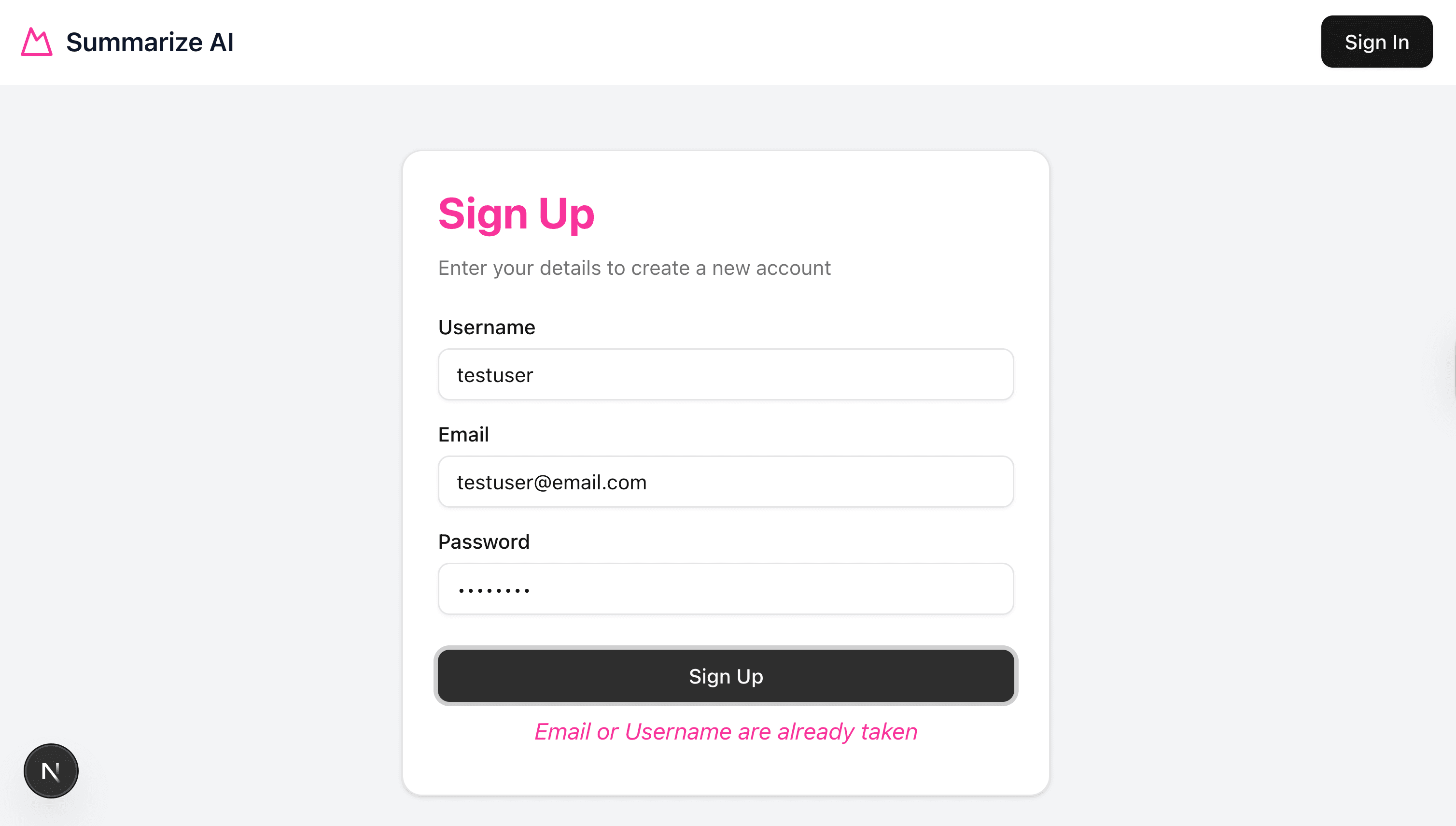
</CardFooter>Let's test and see if we can see our Strapi Errors. Try creating another user with an email you used to make your first user.
You should see the following message.
Let's improve our submit button by adding a pending state and making it prettier.
How To Handle Pending State In Next.js With useFormStatus
When we submit a form, it may be in a pending state, and we would like to show a spinner for a better user experience.
Let's look at how we can accomplish this by creating a SubmitButton component that will utilize the useFormStatus hook. The Next.js docs provide more details here.
The useFormStatus Hook gives you the status information of the last form submission. We will use that to get the status of our form and show our loading spinner.
Let's start by navigating to app/components/custom, creating the following file name submit-button.tsx, and adding the following code.
"use client";
import { useFormStatus } from "react-dom";
import { cn } from "@/lib/utils";
import { Button } from "@/components/ui/button";
import { Loader2 } from "lucide-react";

function Loader({ text }: { readonly text: string }) {
  return (
    <div className="flex items-center space-x-2">
      <Loader2 className="mr-2 h-4 w-4 animate-spin" />
      <p>{text}</p>
    </div>
  );
}

interface IButtonProps {
  text: string;
  loadingText: string;
  className?: string;
  loading?: boolean;
}

export function SubmitButton({
  text,
  loadingText,
  loading,
  className,
}: IButtonProps) {
  const status = useFormStatus();
  return (
    <Button
      type="submit"
      aria-disabled={status.pending || loading}
      disabled={status.pending || loading}
      className={cn(className)}
    >
      {status.pending || loading ? <Loader text={loadingText} /> : text}
    </Button>
  );
}
Now that we have our new SubmitButton component, let's use it inside our signup-form.tsx file.
Let's replace our boring button with the following, but first, ensure you import it.
import { SubmitButton } from "@/components/custom/submit-button";Inside our CardFooter, let's update you with the following:
<CardFooter className={styles.footer}>
  <SubmitButton className="w-full" text="Sign Up" loadingText="Loading" />
  <StrapiErrors error={formState?.strapiErrors} />
</CardFooter>
Now let's test our new beautiful button.
It's beautiful.
The last two things we need to do are to look at how to set our JWT token as a httpOnly cookie, handle redirects, and set up protected routes with the middleware.ts file.
How To Set HTTP Only Cookie in Next.js
We will add this logic to our src/data/actions/auth file in our registerUserAction function.
You can learn more about setting cookies in Next.js on their docs here
Let's make the following change inside of our registerUserAction file.
First import cookies and redirect from Next:
import { cookies } from "next/headers";
import { redirect } from "next/navigation";
Next, create a variable to store our cookies config.
const config = {
  maxAge: 60 * 60 * 24 * 7, // 1 week
  path: "/",
  domain: process.env.HOST ?? "localhost",
  httpOnly: true,
  secure: process.env.NODE_ENV === "production",
};
Finally, use the following code to set the cookie.
const cookieStore = await cookies();
cookieStore.set("jwt", responseData.jwt, config);
redirect("/dashboard");
You can now remove the following last return since we will never reach it due to our redirect.
return {
  success: true,
  message: "User registration successful",
  strapiErrors: null,
  zodErrors: null,
  data: {
    ...prevState.data,
    ...fields,
  },
};
The final code should look like the following. Notice we are using the redirect function from Next.js to redirect the user to the dashboard page; you can learn more here.
"use server";

import { z } from "zod";
import { cookies } from "next/headers";
import { redirect } from "next/navigation";
import { services } from "@/data/services";
import { isAuthError } from "@/data/services/auth";

import { SignupFormSchema, type FormState } from "@/data/validation/auth";

const config = {
  maxAge: 60 * 60 * 24 * 7, // 1 week
  path: "/",
  domain: process.env.HOST ?? "localhost",
  httpOnly: true,
  secure: process.env.NODE_ENV === "production",
};

export async function registerUserAction(
  prevState: FormState,
  formData: FormData
): Promise<FormState> {
  console.log("Hello From Register User Action");

  const fields = {
    username: formData.get("username") as string,
    password: formData.get("password") as string,
    email: formData.get("email") as string,
  };

  const validatedFields = SignupFormSchema.safeParse(fields);

  if (!validatedFields.success) {
    const flattenedErrors = z.flattenError(validatedFields.error);
    console.log("Validation failed:", flattenedErrors.fieldErrors);
    return {
      success: false,
      message: "Validation failed",
      strapiErrors: null,
      zodErrors: flattenedErrors.fieldErrors,
      data: {
        ...prevState.data,
        ...fields,
      },
    };
  }

  console.log("Validation successful:", validatedFields.data);

  const responseData = await services.auth.registerUserService(
    validatedFields.data
  );

  if (!responseData) {
    return {
      success: false,
      message: "Ops! Something went wrong. Please try again.",
      strapiErrors: null,
      zodErrors: null,
      data: {
        ...prevState.data,
        ...fields,
      },
    };
  }

  // Check if responseData is an error response
  if (isAuthError(responseData)) {
    return {
      success: false,
      message: "Failed to Register.",
      strapiErrors: responseData.error,
      zodErrors: null,
      data: {
        ...prevState.data,
        ...fields,
      },
    };
  }

  console.log("#############");
  console.log("User Registered Successfully", responseData);
  console.log("#############");

  const cookieStore = await cookies();
  cookieStore.set("jwt", responseData.jwt, config);
  redirect("/dashboard");
}
Notice we are redirecting to our dashboard route; Let's make this page now.
Inside the app folder, create a new folder named (protected). Within that, add a dashboard folder, and inside it create a page.tsx file.
Paste the following code into page.tsx:
export default function DashboardRoute() {
  return (
    <div className="flex flex-col items-center justify-center min-h-screen bg-gray-100 dark:bg-gray-900">
      <h1>Dashboard</h1>
    </div>
  );
}
Let's create another user and see our redirect in action and our cookies set.
You can see here that we are saving it as an httpOnly cookie.

Nice. We are almost done with the authentication flow, but we still have a small issue. If I remove the cookie, we are still able to navigate to the dashboard, but that should be a protected route.
How To Protect Your Routes in Next.js via Middleware
We will use Next.js middleware to protect our routes. You can learn more here.
In the src folder, create a file called middleware.ts and paste it into the following code.
import { NextResponse } from "next/server";
import type { NextRequest } from "next/server";
import { services } from "@/data/services";

// Define an array of protected routes
const protectedRoutes: string[] = ["/dashboard", "/dashboard/*"];

// Helper function to check if a path is protected
function isProtectedRoute(path: string): boolean {
  if (!path || protectedRoutes.length === 0) return false;
  return protectedRoutes.some((route) => {
    // For exact matches
    if (!route.includes("*")) {
      return path === route;
    }

    // For wildcard routes (e.g., /dashboard/*)
    const basePath = route.replace("/*", "");
    return path === basePath || path.startsWith(`${basePath}/`);
  });
}

export async function middleware(request: NextRequest) {
  const currentPath = request.nextUrl.pathname;

  // Only validate authentication for protected routes
  if (isProtectedRoute(currentPath)) {
    try {
      // Validate user using getUserMe service - this checks:
      // 1. Token exists and is valid
      // 2. User exists in database
      // 3. User account is active (not blocked/deleted)
      const userResponse = await services.auth.getUserMeService();

      // If user validation fails, redirect to signin
      if (!userResponse.success || !userResponse.data) {
        return NextResponse.redirect(new URL("/signin", request.url));
      }

      // User is valid, continue to protected route
      return NextResponse.next();
    } catch (error) {
      // If getUserMe throws an error, redirect to signin
      console.error("Middleware authentication error:", error);
      return NextResponse.redirect(new URL("/signin", request.url));
    }
  }

  return NextResponse.next();
}
// Configure matcher for better performance
export const config = {
  matcher: [
    // Match /dashboard and any path under /dashboard
    /*
     * Match all request paths except for the ones starting with:
     * - api (API routes)
     * - _next/static (static files)
     * - _next/image (image optimization files)
     * - favicon.ico (favicon file)
     */
    "/((?!api|_next/static|_next/image|favicon.ico).*)",
    "/dashboard",
    "/dashboard/:path*",
  ],
};
In the code above, we are using the getUserMeService let's go ahead and add it in our src/data/services/auth.ts.
export async function getUserMeService(): Promise<TStrapiResponse<TAuthUser>> {
  const authToken = await actions.auth.getAuthTokenAction();

  if (!authToken)
    return { success: false, data: undefined, error: undefined, status: 401 };

  const url = new URL("/api/users/me", baseUrl);

  try {
    const response = await fetch(url.href, {
      method: "GET",
      headers: {
        "Content-Type": "application/json",
        Authorization: `Bearer ${authToken}`,
      },
    });
    const data = await response.json();
    if (data.error)
      return {
        success: false,
        data: undefined,
        error: data.error,
        status: response.status,
      };
    return {
      success: true,
      data: data,
      error: undefined,
      status: response.status,
    };
  } catch (error) {
    console.log(error);
    return {
      success: false,
      data: undefined,
      error: {
        status: 500,
        name: "NetworkError",
        message:
          error instanceof Error
            ? error.message
            : "An unexpected error occurred",
        details: {},
      },
      status: 500,
    };
  }
}
It is responsible for checking in with Strapi and confirming authenticated user.
Don't forget to export it from the index.ts file:
import {
  registerUserService,
  loginUserService,
  getUserMeService,
} from "./auth";
export const services = {
  auth: {
    registerUserService,
    loginUserService,
    getUserMeService,
  },
};
The complete file should look like the following:
import { getStrapiURL } from "@/lib/utils";
import type { TStrapiResponse, TImage } from "@/types";
import { actions } from "@/data/actions";
import qs from "qs";

type TRegisterUser = {
  username: string;
  password: string;
  email: string;
};

type TLoginUser = {
  identifier: string;
  password: string;
};

type TAuthUser = {
  id: number;
  documentId: string;
  username: string;
  email: string;
  firstName?: string;
  lastName?: string;
  bio?: string;
  image?: TImage;
  credits?: number;
  provider: string;
  confirmed: boolean;
  blocked: boolean;
  createdAt: string;
  updatedAt: string;
  publishedAt: string;
};

type TAuthResponse = {
  jwt: string;
  user: TAuthUser;
};

type TAuthServiceResponse = TAuthResponse | TStrapiResponse<null>;

// Type guard functions
export function isAuthError(
  response: TAuthServiceResponse
): response is TStrapiResponse<null> {
  return "error" in response;
}

export function isAuthSuccess(
  response: TAuthServiceResponse
): response is TAuthResponse {
  return "jwt" in response;
}

const baseUrl = getStrapiURL();

export async function registerUserService(
  userData: TRegisterUser
): Promise<TAuthServiceResponse | undefined> {
  const url = new URL("/api/auth/local/register", baseUrl);

  try {
    const response = await fetch(url, {
      method: "POST",
      headers: {
        "Content-Type": "application/json",
      },
      body: JSON.stringify({ ...userData }),
    });

    const data = (await response.json()) as TAuthServiceResponse;
    console.dir(data, { depth: null });
    return data;
  } catch (error) {
    console.error("Registration Service Error:", error);
    return undefined;
  }
}

export async function loginUserService(
  userData: TLoginUser
): Promise<TAuthServiceResponse> {
  const url = new URL("/api/auth/local", baseUrl);

  try {
    const response = await fetch(url, {
      method: "POST",
      headers: {
        "Content-Type": "application/json",
      },
      body: JSON.stringify({ ...userData }),
    });

    return response.json() as Promise<TAuthServiceResponse>;
  } catch (error) {
    console.error("Login Service Error:", error);
    throw error;
  }
}

export async function getUserMeService(): Promise<TStrapiResponse<TAuthUser>> {
  const authToken = await actions.auth.getAuthTokenAction();

  if (!authToken)
    return { success: false, data: undefined, error: undefined, status: 401 };

  const url = new URL("/api/users/me", baseUrl);

  try {
    const response = await fetch(url.href, {
      method: "GET",
      headers: {
        "Content-Type": "application/json",
        Authorization: `Bearer ${authToken}`,
      },
    });
    const data = await response.json();
    if (data.error)
      return {
        success: false,
        data: undefined,
        error: data.error,
        status: response.status,
      };
    return {
      success: true,
      data: data,
      error: undefined,
      status: response.status,
    };
  } catch (error) {
    console.log(error);
    return {
      success: false,
      data: undefined,
      error: {
        status: 500,
        name: "NetworkError",
        message:
          error instanceof Error
            ? error.message
            : "An unexpected error occurred",
        details: {},
      },
      status: 500,
    };
  }
}
Notice that our getUserMeService is calling getAuthTokenAction(). In thesrc/data/actions/auth.ts let's add the following code:
export async function getAuthTokenAction() {
  const cookieStore = await cookies();
  const authToken = cookieStore.get("jwt")?.value;
  return authToken;
}

export async function logoutUserAction() {
  const cookieStore = await cookies();
  cookieStore.set("jwt", "", { ...config, maxAge: 0 });
  redirect("/");
}
Notice tha we also added logoutUserAction() it will be responsible for clearing out the cookie when logging out.
The final file should look like the following:
"use server";

import { z } from "zod";
import { cookies } from "next/headers";
import { redirect } from "next/navigation";
import { services } from "@/data/services";
import { isAuthError } from "@/data/services/auth";

import { SignupFormSchema, type FormState } from "@/data/validation/auth";

const config = {
  maxAge: 60 * 60 * 24 * 7, // 1 week
  path: "/",
  domain: process.env.HOST ?? "localhost",
  httpOnly: true,
  secure: process.env.NODE_ENV === "production",
};

export async function registerUserAction(
  prevState: FormState,
  formData: FormData
): Promise<FormState> {
  console.log("Hello From Register User Action");

  const fields = {
    username: formData.get("username") as string,
    password: formData.get("password") as string,
    email: formData.get("email") as string,
  };

  const validatedFields = SignupFormSchema.safeParse(fields);

  if (!validatedFields.success) {
    const flattenedErrors = z.flattenError(validatedFields.error);
    console.log("Validation failed:", flattenedErrors.fieldErrors);
    return {
      success: false,
      message: "Validation failed",
      strapiErrors: null,
      zodErrors: flattenedErrors.fieldErrors,
      data: {
        ...prevState.data,
        ...fields,
      },
    };
  }

  console.log("Validation successful:", validatedFields.data);

  const responseData = await services.auth.registerUserService(
    validatedFields.data
  );

  if (!responseData) {
    return {
      success: false,
      message: "Ops! Something went wrong. Please try again.",
      strapiErrors: null,
      zodErrors: null,
      data: {
        ...prevState.data,
        ...fields,
      },
    };
  }

  // Check if responseData is an error response
  if (isAuthError(responseData)) {
    return {
      success: false,
      message: "Failed to Register.",
      strapiErrors: responseData.error,
      zodErrors: null,
      data: {
        ...prevState.data,
        ...fields,
      },
    };
  }

  console.log("#############");
  console.log("User Registered Successfully", responseData);
  console.log("#############");

  const cookieStore = await cookies();
  cookieStore.set("jwt", responseData.jwt, config);
  redirect("/dashboard");
}

export async function logoutUserAction() {
  const cookieStore = await cookies();
  cookieStore.set("jwt", "", { ...config, maxAge: 0 });
  redirect("/");
}

export async function getAuthTokenAction() {
  const cookieStore = await cookies();
  const authToken = cookieStore.get("jwt")?.value;
  return authToken;
}
Don't forget to add to the export in the index.ts file:
import {
  registerUserAction,
  logoutUserAction,
  getAuthTokenAction,
} from "./auth";

export const actions = {
  auth: {
    registerUserAction,
    logoutUserAction,
    getAuthTokenAction,
  },
};
Now let's create a log out button that we can use in our dashboard. Navigate to src/components/custom and create a file called logout-button and paste in the following:
import { actions } from "@/data/actions";
import { LogOut } from "lucide-react";

export function LogoutButton() {
  return (
    <form action={actions.auth.logoutUserAction}>
      <button type="submit">
        <LogOut className="w-6 h-6 hover:text-primary" />
      </button>
    </form>
  );
}
Now let's add it in our app/(protected)dashboard/page.tsx file:
import { LogoutButton } from "@/components/custom/logout-button";

export default function DashboardRoute() {
  return (
    <div className="flex flex-col items-center justify-center min-h-screen bg-gray-100 dark:bg-gray-900">
      <h1>Dashboard</h1>
      <LogoutButton />
    </div>
  );
}
Now let's create a new user, logout, and try to navigate to the the dashboard, you will notice, we will be redirected to our login route.
Nice. Great job.
Nice. Now that we know our middleware is working, let's work on hooking up our SigninForm instead of going step by step like we did. Since we will basically do the same thing we did in the SignupForm, we are just going to paste in the completed code.
Let's update the sign-form.tsx file with the following.
"use client";
import { actions } from "@/data/actions";
import { useActionState } from "react";
import { type FormState } from "@/data/validation/auth";
import Link from "next/link";
import {
CardTitle,
CardDescription,
CardHeader,
CardContent,
CardFooter,
Card,
} from "@/components/ui/card";
import { Label } from "@/components/ui/label";
import { Input } from "@/components/ui/input";
import { SubmitButton } from "@/components/custom/submit-button";
import { ZodErrors } from "@/components/custom/zod-errors";
import { StrapiErrors } from "@/components/custom/strapi-errors";
const styles = {
container: "w-full max-w-md",
header: "space-y-1",
title: "text-3xl font-bold text-pink-500",
content: "space-y-4",
fieldGroup: "space-y-2",
footer: "flex flex-col",
button: "w-full",
prompt: "mt-4 text-center text-sm",
link: "ml-2 text-pink-500",
};
const INITIAL_STATE: FormState = {
success: false,
message: undefined,
strapiErrors: null,
zodErrors: null,
};
export function SigninForm() {
const [formState, formAction] = useActionState(
actions.auth.loginUserAction,
INITIAL_STATE
);
return (
<div className={styles.container}>
<form action={formAction}>
<Card>
<CardHeader className={styles.header}>
<CardTitle className={styles.title}>Sign In</CardTitle>
<CardDescription>
Enter your details to sign in to your account
</CardDescription>
</CardHeader>
<CardContent className={styles.content}>
<div className={styles.fieldGroup}>
<Label htmlFor="email">Username or Email</Label>
<Input
id="identifier"
name="identifier"
type="text"
placeholder="username or email"
defaultValue={formState?.data?.identifier || ""}
/>
<ZodErrors error={formState?.zodErrors?.identifier} />
</div>
<div className={styles.fieldGroup}>
<Label htmlFor="password">Password</Label>
<Input
id="password"
name="password"
type="password"
placeholder="password"
defaultValue={formState?.data?.password || ""}
/>
<ZodErrors error={formState?.zodErrors?.password} />
</div>
</CardContent>
<CardFooter className={styles.footer}>
<SubmitButton
className="w-full"
text="Sign In"
loadingText="Loading"
/>
<StrapiErrors error={formState?.strapiErrors} />
</CardFooter>
</Card>
<div className={styles.prompt}>
Don't have an account?
<Link className={styles.link} href="signup">
Sign Up
</Link>
</div>
</form>
</div>
);
}Our form expects our loginUserAction, let's add it in our src/data/actions/auth.ts file:
export async function loginUserAction(
  prevState: FormState,
  formData: FormData
): Promise<FormState> {
  console.log("Hello From Login User Action");

  const fields = {
    identifier: formData.get("identifier") as string,
    password: formData.get("password") as string,
  };

  console.dir(fields);

  const validatedFields = SigninFormSchema.safeParse(fields);

  if (!validatedFields.success) {
    const flattenedErrors = z.flattenError(validatedFields.error);
    console.log("Validation failed:", flattenedErrors.fieldErrors);
    return {
      success: false,
      message: "Validation failed",
      strapiErrors: null,
      zodErrors: flattenedErrors.fieldErrors,
      data: {
        ...prevState.data,
        ...fields,
      },
    };
  }

  console.log("Validation successful:", validatedFields.data);

  const responseData = await services.auth.loginUserService(
    validatedFields.data
  );

  if (!responseData) {
    return {
      success: false,
      message: "Ops! Something went wrong. Please try again.",
      strapiErrors: null,
      zodErrors: null,
      data: {
        ...prevState.data,
        ...fields,
      },
    };
  }

  // Check if responseData is an error response
  if (isAuthError(responseData)) {
    return {
      success: false,
      message: "Failed to Login.",
      strapiErrors: responseData.error,
      zodErrors: null,
      data: {
        ...prevState.data,
        ...fields,
      },
    };
  }

  console.log("#############");
  console.log("User Login Successfully", responseData);
  console.log("#############");

  const cookieStore = await cookies();
  cookieStore.set("jwt", responseData.jwt, config);
  redirect("/dashboard");
}
Our loginUserAction is expecting the SigninFormSchema, let's add the following import:
import {
  SignupFormSchema,
  SigninFormSchema,
  type FormState,
} from "@/data/validation/auth";
And don't forget to add it you our export in the index.ts file:
import {
  registerUserAction,
  loginUserAction,
  logoutUserAction,
  getAuthTokenAction,
} from "./auth";

export const actions = {
  auth: {
    registerUserAction,
    loginUserAction,
    logoutUserAction,
    getAuthTokenAction,
  },
};
The completed file will look like the following:
"use server";

import { z } from "zod";
import { cookies } from "next/headers";
import { redirect } from "next/navigation";
import { services } from "@/data/services";
import { isAuthError } from "@/data/services/auth";

import {
  SignupFormSchema,
  SigninFormSchema,
  type FormState,
} from "@/data/validation/auth";

const config = {
  maxAge: 60 * 60 * 24 * 7, // 1 week
  path: "/",
  domain: process.env.HOST ?? "localhost",
  httpOnly: true,
  secure: process.env.NODE_ENV === "production",
};

export async function registerUserAction(
  prevState: FormState,
  formData: FormData
): Promise<FormState> {
  console.log("Hello From Register User Action");

  const fields = {
    username: formData.get("username") as string,
    password: formData.get("password") as string,
    email: formData.get("email") as string,
  };

  const validatedFields = SignupFormSchema.safeParse(fields);

  if (!validatedFields.success) {
    const flattenedErrors = z.flattenError(validatedFields.error);
    console.log("Validation failed:", flattenedErrors.fieldErrors);
    return {
      success: false,
      message: "Validation failed",
      strapiErrors: null,
      zodErrors: flattenedErrors.fieldErrors,
      data: {
        ...prevState.data,
        ...fields,
      },
    };
  }

  console.log("Validation successful:", validatedFields.data);

  const responseData = await services.auth.registerUserService(
    validatedFields.data
  );

  if (!responseData) {
    return {
      success: false,
      message: "Ops! Something went wrong. Please try again.",
      strapiErrors: null,
      zodErrors: null,
      data: {
        ...prevState.data,
        ...fields,
      },
    };
  }

  // Check if responseData is an error response
  if (isAuthError(responseData)) {
    return {
      success: false,
      message: "Failed to Register.",
      strapiErrors: responseData.error,
      zodErrors: null,
      data: {
        ...prevState.data,
        ...fields,
      },
    };
  }

  console.log("#############");
  console.log("User Registered Successfully", responseData);
  console.log("#############");

  const cookieStore = await cookies();
  cookieStore.set("jwt", responseData.jwt, config);
  redirect("/dashboard");
}

export async function loginUserAction(
  prevState: FormState,
  formData: FormData
): Promise<FormState> {
  console.log("Hello From Login User Action");

  const fields = {
    identifier: formData.get("identifier") as string,
    password: formData.get("password") as string,
  };

  console.dir(fields);

  const validatedFields = SigninFormSchema.safeParse(fields);

  if (!validatedFields.success) {
    const flattenedErrors = z.flattenError(validatedFields.error);
    console.log("Validation failed:", flattenedErrors.fieldErrors);
    return {
      success: false,
      message: "Validation failed",
      strapiErrors: null,
      zodErrors: flattenedErrors.fieldErrors,
      data: {
        ...prevState.data,
        ...fields,
      },
    };
  }

  console.log("Validation successful:", validatedFields.data);

  const responseData = await services.auth.loginUserService(
    validatedFields.data
  );

  if (!responseData) {
    return {
      success: false,
      message: "Ops! Something went wrong. Please try again.",
      strapiErrors: null,
      zodErrors: null,
      data: {
        ...prevState.data,
        ...fields,
      },
    };
  }

  // Check if responseData is an error response
  if (isAuthError(responseData)) {
    return {
      success: false,
      message: "Failed to Login.",
      strapiErrors: responseData.error,
      zodErrors: null,
      data: {
        ...prevState.data,
        ...fields,
      },
    };
  }

  console.log("#############");
  console.log("User Login Successfully", responseData);
  console.log("#############");

  const cookieStore = await cookies();
  cookieStore.set("jwt", responseData.jwt, config);
  redirect("/dashboard");
}

export async function logoutUserAction() {
  const cookieStore = await cookies();
  cookieStore.set("jwt", "", { ...config, maxAge: 0 });
  redirect("/");
}

export async function getAuthTokenAction() {
  const cookieStore = await cookies();
  const authToken = cookieStore.get("jwt")?.value;
  return authToken;
}
Nice, our signin form should now work, let's try it out:
Conclusion
In this Next.js tutorial, we successfully built the Sign In and Sign Up pages for a Next.js application.
We implemented custom Sign In and Sign Up forms with error handling and integrated them with a backend using server actions.
Using useActionState and Zod for form validation ensured data integrity and provided user feedback.
We also covered setting up httpOnly cookies for secure authentication and protecting routes through Next.js middleware, establishing a solid foundation for user authentication flows in Next.js applications.
Thank you for your time, and I hope you are enjoying these tutorials.
If you have any questions, you can ask them in the comments or stop by Strapi's open office on Discord from 12:30 pm CST to 1:30 pm CST Monday through Friday.
See you in the next post, where we will work on building our dashboard.
Note about this project
This project has been updated to use Next.js 15 and Strapi 5.
If you have any questions, feel free to stop by at our Discord Community for our daily "open office hours" from 12:30 PM CST to 1:30 PM CST.
If you have a suggestion or find a mistake in the post, please open an issue on the GitHub repository.
Feel free to make PRs to fix any issues you find in the project, or let me know if you have any questions.
Happy coding!
Paul